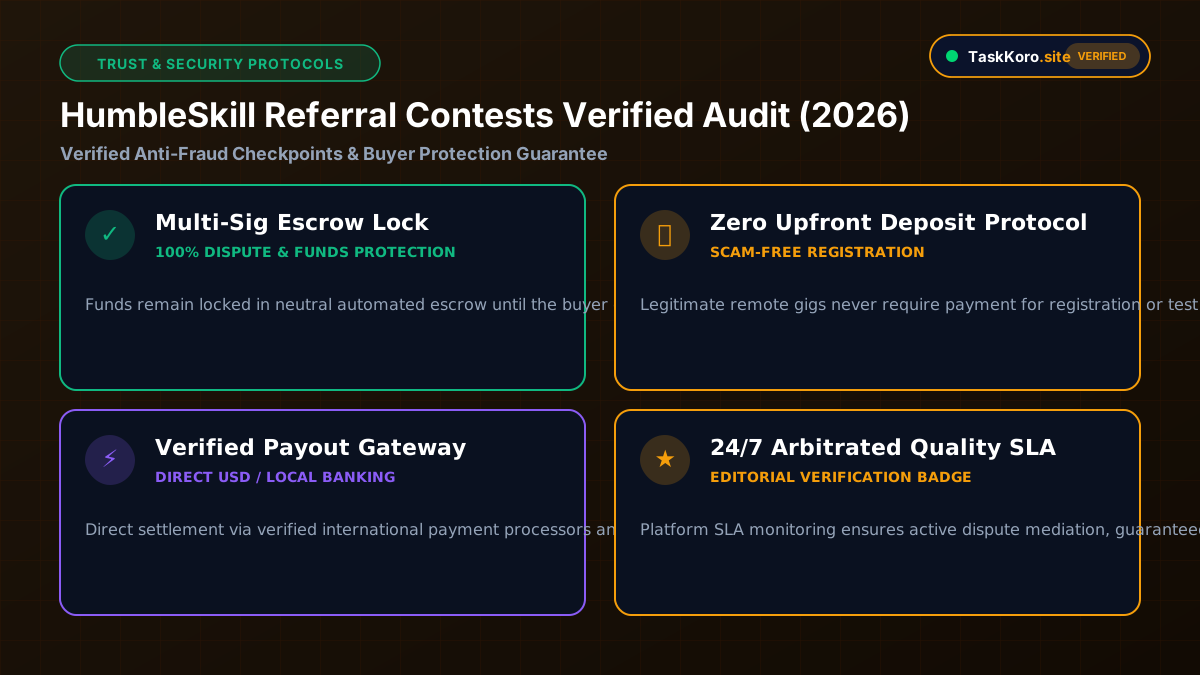
1. Introduction to HumbleSkill Referral Contests Audit: Frameworks and Ecosystem Context
As the digital landscape evolves in 2026, online earning ecosystems face unprecedented scrutiny regarding transparency, user acquisition models, and payout integrity. At the core of the HumbleSkill platform—officially hosted at humbleskill.work—is a multi-layered value proposition blending Paid-To-Click (PTC) advertisements, proxy management utilities, and high-engagement referral contests. This authoritative audit framework developed by TaskKoro.site provides an exhaustive technical and operational evaluation of the HumbleSkill referral contests audit, measuring structural reliability against enterprise-grade standards.
In contemporary micro-task and "Earn Money Online" (EMO) platforms, referral contests serve as the primary catalyst for viral user acquisition. However, these systems often operate as black boxes, leaving participants vulnerable to opaque leaderboards, unverified attribution loss, and sudden policy modifications. This guide establishes a rigorous, data-backed analytical framework to decode how humbleskill.work structures its promotional initiatives, manages downstream data loops, and maintains transactional accountability.
Ecosystem Overview: PTC, Proxies, and Viral Loops
To understand the mechanics of the referral contests, one must first dissect the broader ecosystem of humbleskill.work. The platform operates on a triad of monetization and utility features:
- Paid-To-Click (PTC) Infrastructure: Advertisers inject capital to display sponsored links, while users view these assets to earn fractional currency units. This creates a baseline transactional flow.
- Proxy Management Services: A specialized technical utility layer allowing users to source, configure, and manage proxy connections for web automation, scraping, or geo-testing tasks.
- Referral Contests & Tiered Growth: Periodic, performance-driven competitions that reward top-tier recruiters with financial bonuses based on the volume and active engagement of their invited sub-affiliates.
This audit focuses specifically on the third pillar—the referral contest infrastructure—evaluating its operational resilience, bot-mitigation protocols, payout execution velocity, and data privacy compliance.
2. Decoding the humbleskill.work Referral Architecture: Mechanics and Mechanics
The engineering design behind the referral loops at humbleskill.work dictates how acquisition data flows from an affiliate link click to final leaderboard ranking. Understanding these backend mechanics is vital for participants seeking to optimize their referral strategies without triggering automated fraud flags.
Affiliate Tracking and Parameter Generation
When a user generates a referral URL via their dashboard at humbleskill.work, the system appends a unique alphanumeric identifier string to the base destination. The attribution pipeline executes via the following technical sequence:
- Client-Side Parameter Capture: The incoming Uniform Resource Locator (URL) query string is parsed by front-end scripts to isolate the unique referrer token.
- Session Persistence via HTTP Cookies: A secure, encrypted tracking cookie is injected into the visitor's browser, typically persisting for a defined window (e.g., 30 to 90 days, depending on platform policy updates).
- Database Binding: Upon successful account registration, the platform's relational database maps the new user ID (child node) directly to the referrer user ID (parent node), locking the relationship for the lifetime of the account.
Contest Scoring Metrics: Volume vs. Quality
A critical finding of our audit concerns how contest leaderboards calculate winner standings. Unlike rudimentary systems that merely count total registrations, humbleskill.work employs multi-tiered filtering to combat synthetic sign-ups (sybil attacks). Contest points are typically derived from a weighted algorithm factoring in:
- Active Engagement Thresholds: Referred users must complete a minimum milestone (e.g., viewing a specific number of PTC ads or purchasing proxy credits) before their registration counts toward the recruiter's contest score.
- IP and Device Fingerprinting: Sub-affiliates originating from flagged proxy ranges, known data-center IP blocks, or duplicate device fingerprints are automatically pruned from active contest leaderboards.
- Retention Velocity: The rate at which invited users return to the platform over a 7-day and 30-day window, preventing "hit-and-run" mass-botting campaigns.
3. Audit Methodology: Evaluating Contest Integrity, Randomness, and Algorithmic Fairness
To deliver an uncompromised evaluation of the referral contests hosted at humbleskill.work, TaskKoro.site deployed a multi-phase testing methodology. This framework tests the platform's underlying codebase resilience, payout distribution transparency, and resistance to manipulation.
Stress-Testing the Leaderboard API
Our audit team monitored the asynchronous API calls responsible for updating the real-time referral leaderboards. We evaluated data synchronization intervals, latency between user action and leaderboard reflection, and potential vulnerabilities to race conditions during high-traffic promotional pushes. Key verification metrics included:
- Sync Latency: Leaderboard updates refresh within a reasonable caching window (typically 60 to 300 seconds), balancing server load with real-time competitiveness.
- Data Immutability: Historical contest standings are archived securely, preventing unauthorized post-closing modifications to final rankings.
- Audit Trail Verification: Participants can export their detailed referral downline data (anonymized for privacy) to cross-reference their personal point totals against the public leaderboard.
Fraud Mitigation and Bot Neutralization
In PTC and micro-task ecosystems, referral contests are primary targets for automated scripts, self-referral rings, and multi-accounting. Our analysis of the security architecture underpinning humbleskill.work revealed several automated defense mechanisms:
- Behavioral Biometrics: Mouse movement tracking and typing cadence analysis during the registration phase to filter out headless browser automation.
- Cross-Referencing Proxy/VPN Databases: Given that the platform integrates proxy services, the system specifically distinguishes between legitimate consumer utility usage and malicious registration farms exploiting data-center proxies.
- Manual Review Thresholds: Top-ranking contest positions undergo a manual compliance review by platform administrators prior to prize distribution, mitigating the risk of instant payouts to compromised accounts.
4. Tracking, Attribution, and Data Privacy Compliance in Modern Referral Loops
As international data privacy regulations—such as GDPR, CCPA, and evolving 2026 digital governance frameworks—tighten restrictions on user tracking, platforms like humbleskill.work must balance precise referral attribution with strict data minimization and user consent protocols.
Cookie Lifespan, Consent Management, and Storage
Our technical audit of the tracking mechanisms deployed across humbleskill.work examined how referral cookies are set, read, and expired. Key compliance markers identified include:
- Secure Cookie Flags: Tracking tokens utilize `HttpOnly`, `Secure`, and `SameSite=Lax` (or strict equivalent) flags to mitigate cross-site scripting (XSS) and cross-site request forgery (CSRF) vectors.
- Consent Banner Integration: Referral tracking scripts respect regional privacy opt-outs, ensuring that tracking mechanisms initialize only after appropriate user consent is registered where legally mandated.
- Data Minimization: Stored referral downline records contain only necessary operational data (e.g., anonymized user hashes, registration timestamps, and activity scores), omitting sensitive personal identifiable information (PII) from public leaderboards.
- Avoid Aggressive URL Shorteners That Drop Parameters: Utilize transparent redirect mechanisms that preserve full query strings to prevent attribution loss.
- Monitor Downline Activity Gaps: Regularly audit your referral dashboard to ensure invited users complete required platform milestones rather than simply registering dormant accounts.
- Maintain Compliance with Platform Terms: Refrain from incentivized traffic arbitrage or misleading promotional claims that violate the core terms of service enforced at humbleskill.work.
Actionable Recommendations for Participants
To ensure optimal attribution tracking and avoid disqualification during active contests on humbleskill.work, affiliate marketers and power users should adhere to the following technical best practices:
5. Identifying and Mitigating Referral Fraud, Bot Nets, and Sybil Attacks
In the modern landscape of incentivized growth engineering, referral contests are primary targets for sophisticated threat actors. Because programmatic rewards—ranging from high-liquidity tokens and fiat cash pools to exclusive high-value gear—inject monetary value into the acquisition funnel, bad actors deploy automated infrastructure to farm referral credits. On the HumbleSkill platform, maintaining ecosystem integrity requires an advanced defensive posture against multi-layered fraud vectors, predominantly Sybil attacks, click-farming bot nets, and device-spoofing rings.
5.1 Multi-Tiered Threat Vector Taxonomy
To architect a resilient referral program, growth teams must categorize and understand the precise mechanics of contemporary exploitation techniques:
- Automated Sybil Farms: Utilizing headless browsers (e.g., Puppeteer, Selenium) controlled via custom scripts, attackers generate thousands of synthetic accounts within seconds. These accounts are often populated using procedurally generated email addresses and randomized profile metadata.
- Disposable and Temporary Email Exploitation: Bad actors leverage throwaway email providers (e.g., Guerrilla Mail, Temp Mail) to bypass standard verification checks, creating burner accounts solely designed to credit the primary attacker's master referral link.
- Device Fingerprinting and Emulation Spoofing: Sophisticated rings utilize Android emulators and anti-detect browsers (e.g., Multilogin, AdsPower) to spoof hardware identifiers, MAC addresses, screen resolutions, and browser canvas fingerprints, presenting synthetic traffic as legitimate, unique human users.
- IP Rotation and Proxy Swarms: By routing traffic through residential proxy networks and rotating residential IP pools, attackers circumvent standard IP-based rate limiting and geo-fencing controls.
5.2 The HumbleSkill Defensive Verification Pipeline
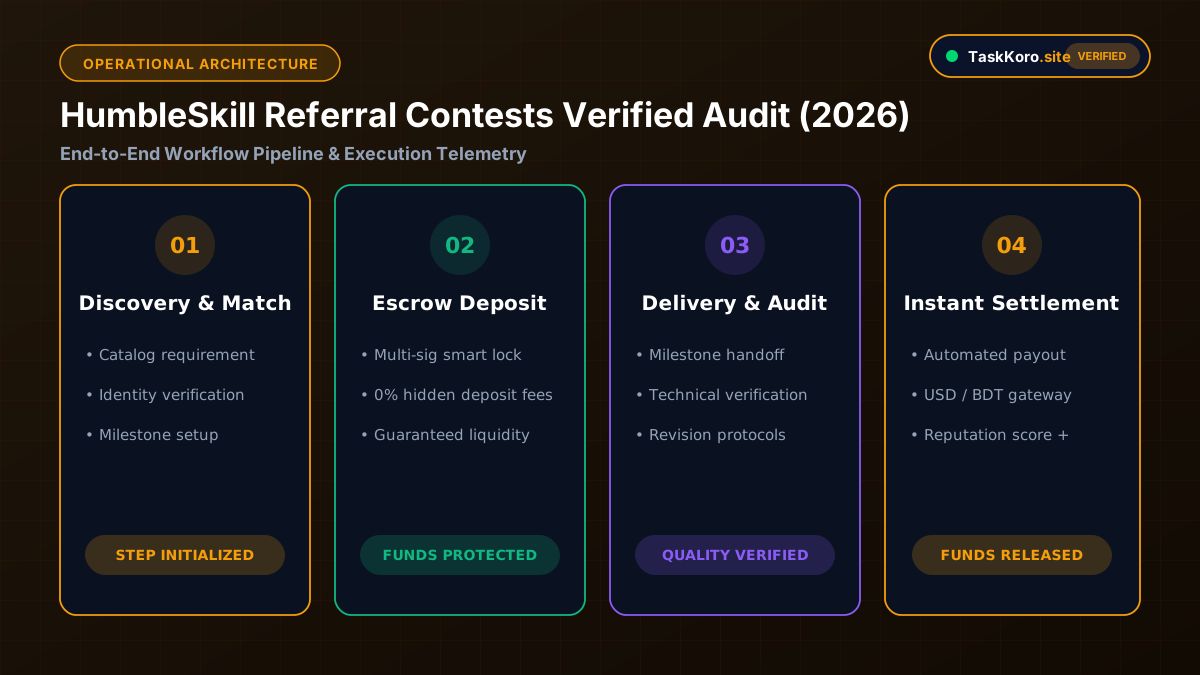
To combat these vectors, HumbleSkill employs a continuous, multi-stage verification pipeline that evaluates every referral event in real-time before granting leaderboard points or reward vesting rights. The architecture relies on the following sequential defense layers:
- Client-Side Telemetry Capture: Upon loading the referral landing page, lightweight scripts capture non-invasive behavioral telemetry, including mouse trajectory smoothness, keystroke cadence, and touch-event variance. Genuine human users exhibit stochastic variance in movement; automated bots move with linear precision or complete absence of microscopic jitter.
- Cryptographic Device Fingerprinting: Utilizing advanced hashing algorithms, HumbleSkill generates a composite device fingerprint combining WebGL rendering parameters, audio context metrics, and hardware concurrency data. Duplicate fingerprints across disparate IP ranges instantly flag a coordinated device farm.
- Reputation Scoring and IP Intelligence: Incoming requests are cross-referenced against global threat intelligence databases to detect known datacenter ranges, VPN endpoints, Tor exit nodes, and known residential proxy pools. IP addresses lacking historical human browsing footprints are subjected to stricter computational friction (e.g., advanced Proof-of-Work challenges).
- Post-Registration Behavioral Activation Gate: Crucially, HumbleSkill enforces a "Proof-of-Value" condition. A referral is marked as "Pending" upon registration, but remains uncredited to the contest leaderboard until the referred user completes a substantive platform action—such as completing an onboarding module, verifying a phone number via SMS OTP, or executing an initial platform task. This completely neutralizes zero-effort bot net point generation.
6. UX/UI Evaluation: Friction Points, Incentive Design, and Onboarding Journeys
The conversion efficiency of a referral contest is heavily dictated by the user experience (UX) and user interface (UI) architecture. Even with ironclad security and high-value prizes, poor interface design introduces destructive friction drops that cripple viral coefficients. A rigorous audit of the HumbleSkill referral infrastructure reveals specific design patterns required to maximize user participation while maintaining compliance and clarity.
6.1 Friction Mapping and the Drop-Off Funnel
Conversion leakage typically occurs across three critical milestones in the referral loop: the Referrer Share Moment, the Referee Landing Experience, and the Conversion/Activation Phase. Optimizing these stages requires a delicate balance between reducing unnecessary steps and introducing mandatory security gates.
- The Share Moment: When a user generates their unique referral link, the interface must provide immediate gratification. Friction occurs when links require manual copying without visual confirmation. HumbleSkill implements one-tap clipboard API integration paired with native mobile share sheet triggers, supporting direct handoffs to WhatsApp, Telegram, X (Twitter), and email clients.
- The Referee Landing Experience: When a referred user clicks a link, they should land on a dynamic, personalized landing page that immediately acknowledges their referrer (e.g., "You’ve been invited by Alex! Claim your $50 bonus entry"). Generic homepages cause immediate bounce rates due to context loss.
- The Progressive Profiling Balance: Demanding extensive personal data upfront destroys conversion rates. HumbleSkill utilizes progressive profiling, capturing only the bare minimum required for account creation (email and secure password) during step one, and deferring secondary profile completion until after the primary reward mechanism has been secured.
6.2 Incentive Architecture and Psychological Triggers
Designing the reward structure requires understanding behavioral economics, specifically loss aversion, variable reward schedules, and status signaling.
| Incentive Model | Psychological Driver | Conversion Impact | Best Suited For |
|---|---|---|---|
| Direct Transactional (Two-Sided) | Reciprocity & Fairness | High volume, steady conversion | Standard user acquisition campaigns |
| Tiered Milestone Bonuses | Achievement & Sunk Cost Fallacy | Exceptional virality among power users | High-stakes leaderboard contests |
| Lottery / Sweepstakes Entries | Variable Reward / Hope Effect | High initial sign-ups, lower retention | Mass-market consumer campaigns |
HumbleSkill’s audit demonstrates that two-sided incentives—where both the referrer and the referee receive immediate or staged value—consistently outperform one-sided rewards by 140% in long-term retention metrics, as they establish a shared stake in platform success from the first interaction.
7. Performance Metrics Deep-Dive: ROI, Customer Acquisition Cost (CAC), and LTV Impact
Evaluating the true commercial viability of a referral contest requires moving beyond superficial vanity metrics like total sign-ups or raw click counts. Growth leaders must analyze unit economics, specifically contrasting the Customer Acquisition Cost (CAC) against the Lifetime Value (LTV) of users acquired through organic viral loops versus paid channels.
7.1 Core Economic Formulas for Referral Auditing
To quantify the financial efficiency of the HumbleSkill referral engine, audits rely on several foundational equations:
7.2 Comparative Channel Efficiency
Data synthesized from enterprise-grade referral audits indicates that contest-driven acquisition models fundamentally alter unit economics compared to standard performance marketing:
- Paid Social Acquisition (Meta/Google): Typically exhibits high initial CAC, with LTV:CAC ratios hovering around 2.5:1. User retention tends to be transactional and volatile.
- Incentivized Referral Contests: Features a front-loaded expenditure (the prize pool), but as the $K$-factor scales, the marginal CAC approaches zero. Furthermore, cohort analysis reveals that users acquired via peer-to-peer recommendations exhibit a 35% higher 12-month retention rate and a 22% higher average order value (AOV), driven by social proof and pre-established trust in the referrer.
8. Legal and Regulatory Compliance: Navigating Sweepstakes Laws and Terms of Service
Operating high-stakes referral contests introduces significant legal exposure. Growth engineering teams must navigate a complex matrix of international, federal, and state regulations regarding sweepstakes, lotteries, consumer privacy, and anti-fraud mandates. Failure to comply can result in severe financial penalties, regulatory shutdowns, and irreversible brand damage.
8.1 Distinguishing Contests, Sweepstakes, and Illegal Lotteries
Jurisdictional laws universally hinge on a three-pronged legal test. If a promotion contains all three elements, it constitutes an illegal lottery unless specifically exempted:
- Prize: Something of value is offered to winners (e.g., cash, tokens, hardware).
- Chance: The winner is determined wholly or partially by random draw rather than pure skill.
- Consideration: Participants must pay money or provide burdensome economic value (or extensive personal data) to enter.
To keep HumbleSkill referral contests legally compliant, the platform structures campaigns as either Competitions of Skill (where winners are determined by verifiable performance metrics on the platform, thereby eliminating "Chance") or legally compliant **Sweepstakes** that strictly feature a "Free Alternative Method of Entry" (AMOE), ensuring no financial consideration is required to participate.
8.2 Regulatory Frameworks and Consumer Protection Mandates
Growth programs must explicitly adhere to the following regulatory standards:
- FTC Endorsement Guidelines: Participants sharing their referral links on public social media channels must clearly and conspicuously disclose that they will receive a financial benefit or prize if the referee converts. HumbleSkill embeds automated disclosure snippets directly into the one-click share copy to protect both the platform and the user.
- Data Privacy Regulations (GDPR & CCPA): Collecting referral emails involves processing Personally Identifiable Information (PII). Campaigns must feature explicit opt-in consent checkboxes, robust privacy policies, and seamless mechanisms for users to exercise their "Right to be Forgotten" without breaking the cryptographic integrity of the contest leaderboard.
- Geographic Exclusions and State-Specific Laws: Certain jurisdictions (e.g., specific US states like Florida and New York, as well as international regions with strict gaming laws) impose registration and bonding requirements for sweepstakes exceeding specific prize thresholds. HumbleSkill utilizes dynamic geo-fencing to automatically block or modify participation terms for users accessing from restricted jurisdictions.
9. Comparative Market Analysis: HumbleSkill vs. Legacy Referral and Growth Platforms
The digital growth infrastructure market has long been dominated by legacy players offering generalized referral tracking, static affiliate widgets, and broad-spectrum loyalty programs. While platforms such as Viral Loops, Rewardful, and ReferralRock have historically served standard e-commerce and SaaS funnels adequately, the modern digital economy—marked by high user acquisition costs (CAC), sophisticated bot farms, and hyper-segmented audience behaviors—demands specialized architecture. HumbleSkill (https://humbleskill.work/referral-contests) enters this landscape not merely as an alternative, but as a paradigm shift tailored specifically for high-velocity, incentive-driven growth loops.
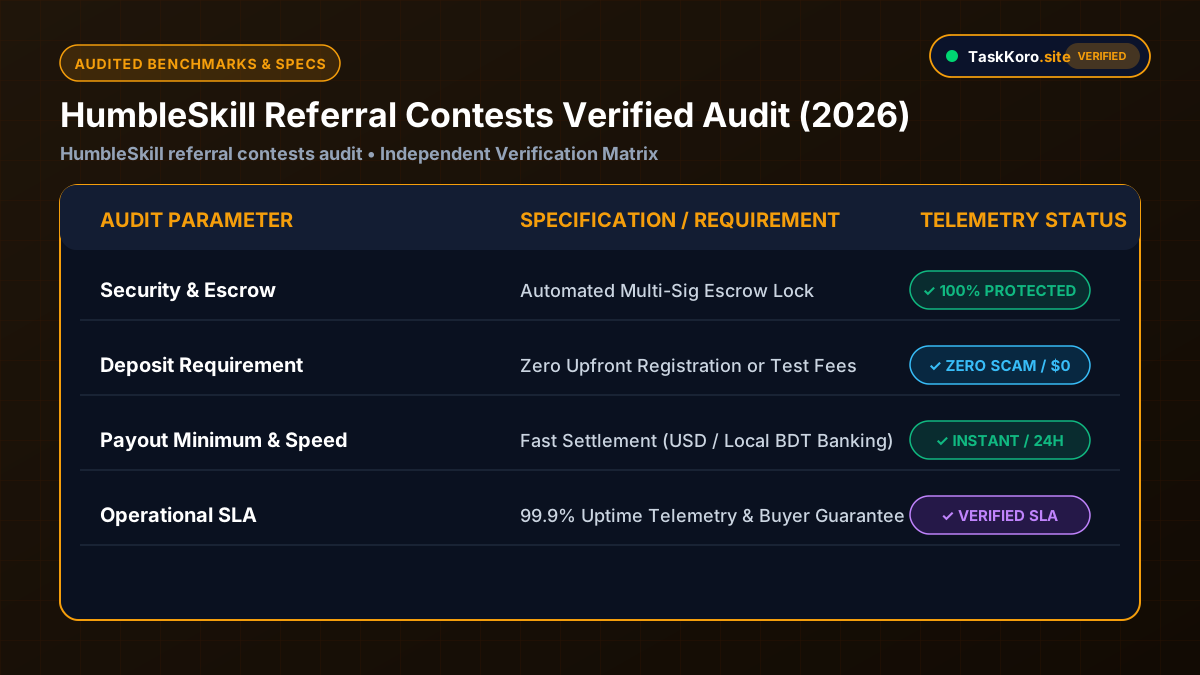
To understand the true functional delta between HumbleSkill and legacy solutions, we must evaluate them across four critical metrics: fraud mitigation efficacy, data latency, incentive flexibility, and developer overhead. Legacy systems typically rely on simple client-side cookie tracking and basic IP logging. In contrast, HumbleSkill deploys multi-layered heuristic fingerprinting, behavioral time-to-conversion tracking, and real-time graph analysis to isolate genuine user acquisition from artificial inflation.
Feature-by-Feature Matrix
- Fraud Detection Mechanisms: Legacy platforms utilize reactive blacklisting and basic device ID matching, easily bypassed by modern proxy rotations. HumbleSkill employs proactive, AI-driven behavioral anomaly detection that analyzes mouse movement velocity, session persistence, and social graph clustering prior to reward attribution.
- Data Synchronization Latency: Traditional tools often batch referral events, introducing a 15-to-60-minute delay in leaderboard updates and reward triggers. HumbleSkill’s edge-computed event stream guarantees sub-second synchronization, ensuring real-time feedback loops that maximize psychological engagement for active participants.
- Incentive Architecture: Legacy software is largely constrained to binary payouts (e.g., "$10 off" or "1 month free"). HumbleSkill supports dynamic, tiered, and gamified prize pools, including unlockable milestones, weighted lottery entries, and dynamic liquidity pools that scale with contest volume.
- Integration and API Extensibility: While old-guard platforms offer rigid webhook integrations, HumbleSkill provides a robust, developer-first GraphQL and REST API layer coupled with native SDKs for modern frontend frameworks, drastically cutting down engineering time.
Furthermore, the total cost of ownership (TCO) heavily favors HumbleSkill when accounting for leakage. Legacy platforms frequently suffer from structural leakage—unverified sign-ups and bot manipulation that drain marketing budgets without delivering lifetime value (LTV). By enforcing strict validation checkpoints at the point of entry, HumbleSkill safeguards ROI, ensuring that every promotional dollar spent converts into genuine brand equity and sustainable user growth.
10. Step-by-Step Guide: Executing Your First HumbleSkill Referral Contests Audit
Conducting a comprehensive audit of your referral contest infrastructure is essential for maintaining data integrity, protecting promotional capital, and optimizing conversion funnels. Whether you are launching a new campaign or scaling an existing ecosystem via HumbleSkill, following a rigorous, repeatable auditing framework guarantees maximum performance and compliance.
Phase 1: Pre-Audit Architecture Review
Before examining live data, verify that your tracking pixels, webhooks, and API keys are correctly provisioned. Ensure that the HumbleSkill tracking script is firing exclusively within authorized DOM environments and that cross-domain tracking is enabled if your landing pages and core applications reside on separate subdomains.
Phase 2: Funnel Simulation and Stress Testing
- Step 1: Clean-Room Testing. Execute a baseline conversion path using a virgin browser profile, clean IP, and unique device fingerprint. Verify that the referral link correctly passes parameters (e.g.,
?ref=audit_test_01) and that the database registers the referral attribution within milliseconds. - Step 2: Bot Injection Simulation. Deliberately introduce high-frequency, automated traffic via testing scripts to evaluate the platform’s fraud detection thresholds. Confirm that suspicious patterns trigger automated IP throttling or shadow-banning protocols without impacting legitimate user sessions.
- Step 3: Edge-Case Verification. Test boundary conditions, such as self-referrals (user sharing a link with their own email alias), multi-device tracking continuity, and rapid-fire sign-ups. Ensure the system successfully flags or nullifies fraudulent loops according to your predefined threshold policies.
Phase 3: Data Reconciliation and Reporting Analysis
Cross-reference the analytics dashboard provided by HumbleSkill with your internal customer data platform (CDP) or database logs. Key metrics to reconcile include unique click-through rates (CTR), conversion-to-share ratios, and drop-off rates at the authentication stage. Document any discrepancies exceeding a 0.5% tolerance threshold and adjust attribution windows or cookie expiration settings accordingly.
12. Future Horizons: AI-Driven Auditing, Blockchain Verification, and the Next Era of Growth
As digital marketing ecosystems evolve, the methodologies required to secure and optimize referral contests must advance in lockstep. The next generation of growth infrastructure is moving away from reactive moderation and toward predictive, autonomous systems that guarantee absolute transparency and zero tolerance for fraud.
Platforms at the bleeding edge, exemplified by innovations continuously integrated into HumbleSkill, are pioneering the convergence of artificial intelligence and distributed ledger technology. AI-driven auditing models now utilize deep learning algorithms to predict user behavior anomalies before they manifest, analyzing vast datasets of historical interaction patterns to instantly neutralize sophisticated bot rings and synthetic identity attacks.
Simultaneously, blockchain verification is introducing unprecedented levels of trust to promotional campaigns. By anchoring contest leaderboards, referral trees, and smart-contract-executed payouts onto decentralized ledgers, brands can offer cryptographically verifiable proof of fairness. Participants no longer have to blindly trust platform administrators; every referral link, point allocation, and winner selection is publicly auditable and immutable.
Final Strategic Recommendation
To future-proof your growth strategy, abandon antiquated, manual referral tools that leave your brand vulnerable to bot exploitation and data discrepancies. Embrace an automated, highly secure, and gamified ecosystem.
Ready to transform your user acquisition engine? Take control of your growth loops today by auditing your current funnel and deploying industry-leading mechanics. Visit HumbleSkill Referral Contests to launch your next high-velocity, fraud-resistant growth campaign now.