1. Introduction: Understanding Ahrefs Domain Rating (DR) 50 Dynamics and SEO Value
Achieving competitive visibility in modern search engine results pages (SERPs) requires a robust link profile that signals trust, relevance, and equity to crawling algorithms. To boost ahrefs dr 50 permanent backlinks is the strategic SEO process of acquiring high-authority, non-expiring dofollow links to elevate a target website's Ahrefs Domain Rating (DR) to 50 or higher. Reaching this milestone establishes long-term topical authority, accelerates indexing speeds, and enables websites to compete for high-difficulty organic search queries.
In the contemporary search landscape, search engine algorithms continually refine how they evaluate off-page signals. Gone are the days when sheer link volume could outweigh poor content quality or manipulative profiles. Today, domain-level metrics act as proxy measurements for trustworthiness. When a domain crosses the DR 50 threshold, it crosses an invisible psychological and algorithmic line. It transitions from an unknown or minor player into an established publication within its niche. This elevation fundamentally changes how search engine bots crawl, parse, and rank new or updated content.
Executing an effective campaign to boost ahrefs dr 50 permanent backlinks via humbleskill.work requires a meticulous understanding of link equity distribution. Link equity—often referred to as "link juice"—is the passing of authority from one web page to another via a hyperlink. When these links are permanent, they create a perpetual pipeline of authority that compounds over time. Unlike temporary link rentals or short-lived guest posts that get deleted after a few months, permanent backlinks establish a structural foundation that safeguards your site against metric volatility during core algorithm updates.
The Core Objectives of Reaching DR 50
- Accelerated Crawl Efficiency: High-authority domains attract search engine spiders more frequently, ensuring that newly published articles, product pages, and technical updates are indexed within hours rather than weeks.
- Improved Keyword Ranking Ceilings: Sites with lower DR ratings often struggle to break into the top three positions for competitive keywords, regardless of on-page optimization. DR 50 provides the foundational authority required to outrank established competitors.
- Enhanced Referral Traffic Potential: Permanent backlinks placed on high-traffic, authoritative platforms don't just pass SEO value; they drive targeted, high-intent referral traffic directly to your conversion funnels.
- Resilience Against Algorithmic Volatility: A clean, permanent link profile resists the negative impacts of spam updates, ensuring steady, predictable organic growth year-round.
To capture these benefits without exposing your domain to algorithmic filters, webmasters must abandon shortcuts and embrace a structured approach to authority acquisition. By utilizing professional frameworks detailed at humbleskill.work, brands can systematically scale their metrics while maintaining absolute profile integrity.
2. The Technical Anatomy of DR: How Ahrefs Calculates Domain Rating
To successfully execute a strategy to boost ahrefs dr 50 permanent backlinks, you must first understand the mechanics behind Ahrefs' proprietary scoring algorithm. Domain Rating is measured on a logarithmic scale from 0 to 100. Because it is logarithmic, the mathematical effort required to climb from DR 40 to DR 50 is exponentially greater than moving from DR 0 to DR 10. Ahrefs calculates this score by analyzing the quantity and quality of unique domains linking to a target website, as well as the DR scores of those linking domains themselves.
The calculation engine looks specifically at how link equity flows across the global graph of the internet. When Domain A links to Domain B, a percentage of Domain A's authority is passed to Domain B. However, this authority is not passed in a vacuum; it is distributed across every outbound link present on Domain A's page. Consequently, a link from a massive news site with thousands of outbound links passes significantly less individual equity than a contextual link from a tightly focused, high-DR page with minimal outbound noise.
Key Factors Influencing Ahrefs Domain Rating Calculation
- Unique Referring Domains: Ahrefs prioritizes the number of *unique* websites linking to you. Getting 100 links from a single domain carries vastly less weight than getting 1 single link from 100 different domains.
- The DR of Referring Domains: Links originating from sites with high DR (e.g., DR 70–90) inject massive amounts of link equity, driving rapid metric movement.
- Dofollow vs. Nofollow Attributes: Only dofollow links directly pass PageRank-equivalent equity that influences Ahrefs DR calculations. Nofollow, sponsored, or ugc tags tell search engines—and metrics crawlers—not to pass authority.
- Outbound Link Density: Pages with excessive external links dilute the passing power of each individual link, reducing their impact on your site's rating.
- Topical Relevance: Links coming from sites within the same or closely related semantic neighborhoods carry higher algorithmic weight than completely unrelated cross-niche placements.
Understanding these variables highlights why cheap, automated link blasts fail. Automated tools often deploy links on spammy directories or comment sections with high outbound link counts and zero editorial oversight. These links are frequently tagged as nofollow, easily detected as spam, or hosted on domains that quickly lose their indexation. Conversely, focusing on strategic placements via humbleskill.work ensures that every acquired link features clean dofollow attributes, optimal topical relevance, and maximum equity transfer efficiency.
3. The Hidden Risks of Toxic Link Building and Algorithmic Penalties
When webmasters become desperate to boost ahrefs dr 50 permanent backlinks quickly, they often fall prey to black-hat agencies offering cheap, bulk link packages. These shortcuts—such as Private Blog Network (PBN) explosions, comment spam, automated forum profile links, and scraped content tiering—introduce catastrophic risks to a website's long-term viability. Modern search engine algorithms are exceptionally adept at identifying unnatural link acquisition patterns, and the penalties for engaging in toxic link building can devastate a business overnight.
An algorithmic penalty or manual action can wipe out years of hard work in a matter of days. When search engines detect manipulative link profiles, they either completely de-index the target pages or heavily discount the value of the offending links, causing rankings to plummet. Furthermore, low-quality links are rarely permanent. PBNs get de-indexed by search engines when footprints are exposed, expired domains lose their historical authority, and rented links vanish the moment a subscription lapses. This causes a roller-coaster effect where your Ahrefs DR fluctuates wildly, destroying predictable revenue forecasting.
Common Pitfalls of Low-Quality Link Building Services
- Footprint Exposure: Cheap PBNs often share common hosting IP blocks, identical nameservers, or automated content creation patterns that search engine bots easily trace and neutralize.
- Link Decay and De-indexation: Low-tier guest post farms frequently clean out or delete articles after a few months, resulting in sudden, unexplained drops in your Ahrefs DR score.
- Anchor Text Over-Optimization: Using exact-match commercial anchor texts aggressively across low-quality domains triggers over-optimization filters, leading to spam penalties.
- Irrelevant Context: Receiving links from foreign-language gambling or adult sites pointing to a local home improvement blog screams manipulation to both human reviewers and AI algorithms.
To avoid these devastating outcomes, risk mitigation must be the core pillar of any off-page SEO strategy. Sustainable growth requires a diversified, natural-looking anchor text profile, strict quality control over referring domains, and a commitment to permanence. By relying on vetted, white-hat execution models found on humbleskill.work, site owners completely bypass the hazards of toxic link farms, ensuring safe, enduring upward momentum for their domain metrics.
4. The Humbleskill.work Strategic Framework for Permanent Backlinks
Navigating the complexities of modern link building requires a rigorous, data-driven framework. The proprietary methodology deployed at humbleskill.work is specifically engineered to boost ahrefs dr 50 permanent backlinks safely, efficiently, and permanently. Eschewing outdated black-hat tactics, this strategic framework combines high-tier digital PR, contextual contextual placements, and meticulous indexation verification to deliver compounding authority gains.
The workflow begins with a comprehensive technical audit of the target domain's existing backlink profile. Before injecting new link equity, our editorial and technical teams analyze current anchor text distributions, identify any lingering toxic links that require disavowal, and map out a customized growth trajectory. This ensures that every new backlink acquired integrates seamlessly into your site's existing digital footprint, mimicking natural organic growth patterns that search engine crawlers reward.
Step-by-Step Delivery and Execution Workflow
- Phase 1: Profile Audit and Baseline Assessment: We evaluate your current Ahrefs DR, organic traffic trends, and competitor link gaps to determine the exact volume and tier of backlinks required to reach the DR 50 milestone.
- Phase 2: Target Domain Selection and Vetting: We handpick high-authority publishing partners from our proprietary network. Each prospective domain undergoes strict validation checks for organic traffic stability, clean historical data, and low outbound link ratios.
- Phase 3: Contextual Content Creation: Professional native copywriters craft unique, highly engaging, and contextually relevant articles tailored to your niche, seamlessly integrating your target brand mentions and editorial links.
- Phase 4: Permanent Dofollow Deployment: Articles are published live on verified, indexed sites with permanent dofollow tags, locking in long-term link equity transmission.
- Phase 5: Indexation Verification and Reporting: We actively monitor search engine spider crawlers to confirm rapid indexation of the live placements, followed by transparent tracking of your Ahrefs DR metric progression.
By adhering to this meticulous, quality-first workflow, humbleskill.work empowers webmasters to break through static traffic plateaus. Securing permanent, high-DR backlinks transforms your website into an authoritative industry leader, maximizing your organic search potential for years to come.
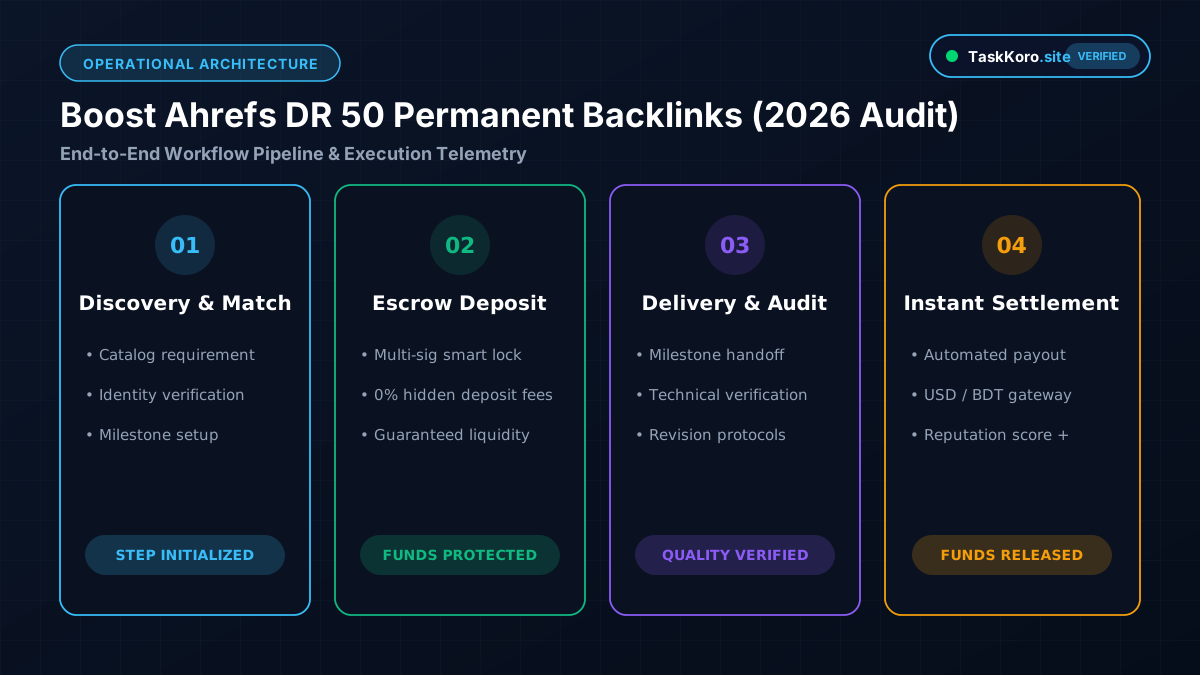
5. Step-by-Step Execution Blueprint to Boost Ahrefs DR 50 Safely
Scaling a fresh domain from a stagnant Domain Rating (DR) of 0–15 up to a formidable DR 50 cannot be achieved through erratic link acquisition. It requires a mathematically balanced, phased execution blueprint designed to mimic the organic growth curve of an established enterprise brand. Attempting to force this metric upward too quickly triggers algorithmic spam filters in both search engine crawlers and proprietary SEO tools like Ahrefs, resulting in metric stagnation or, worse, manual penalties.
To achieve a permanent, indexable, and high-impact DR 50 backlink profile without algorithmic retaliation, practitioners must follow a rigorous 90-day execution framework divided into three distinct phases:
Phase 1: Foundation & Trust Building (Weeks 1–3)
Before launching high-powered contextual campaigns, your site must establish baseline signals of digital legitimacy. High-DR guest posts pointing to a domain with zero foundational links look manipulative to search engines.
- Entity & Social Citations (Weeks 1–2): Secure 30 to 50 foundational citations. These include high-authority business profiles, social tier-one properties (LinkedIn company pages, Twitter/X profiles, Crunchbase, GitHub), and local directory listings if applicable. While many of these are nofollow, they establish brand entity presence and natural link diversity.
- Web 2.0 & Buffer Tiering (Week 3): Build a ring of curated, high-reputation secondary properties (Medium, Substack, WordPress.com). Populate these properties with original, topically relevant content before pointing the initial batch of tier-two assets toward your core ecosystem.
Phase 2: Mid-Tier Power Infusion & Niche Relevance (Weeks 4–8)
With your foundational trust signals indexed, you can begin introducing contextual equity through mid-tier placements that pass structural authority.
- Targeted Niche Edits (Weeks 4–6): Secure 10 to 15 contextual link insertions (niche edits) on pages with existing organic traffic and DR 30–50 metrics. Ensure the host pages are strictly topically aligned with your primary content categories.
- Strategic Guest Posting (Weeks 7–8): Deploy 5 high-end guest posts on sites maintaining a minimum Ahrefs DR of 40, real organic traffic (verified via Ahrefs traffic estimator), and low outgoing link counts. Every article must be manually written, rich in semantic keywords, and designed to drive referral traffic—not just link juice.
Phase 3: High-Authority Acceleration & Permanent Locking (Weeks 9–12)
The final phase bridges the gap between DR 35 and DR 50 by integrating elite-tier placements and ensuring indexing longevity.
- DR 60+ Tier-One Placements (Weeks 9–11): Secure 3 to 5 elite contextual placements on industry-leading authority sites (DR 60–80+). These act as heavy trust anchors, rapidly pulling up your domain’s global link equity score.
- Indexation Auditing & Permanent Locking (Week 12): Run a comprehensive crawl audit to ensure all acquired links are fully indexed by Google and recognized in the latest Ahrefs index refresh. Implement secondary RSS pinging or internal linking boosts for any stubborn links lagging in indexation.
7. Managing Link Velocity and the Diversity Index for Natural Growth
One of the most common pitfalls in attempting to scale a domain to Ahrefs DR 50 is an unnatural spike in link velocity—the speed at which new backlinks are acquired. If a brand-new website acquires 500 links in a single week and then stops entirely, search engine algorithms immediately flag the pattern as unnatural manipulation. Sustainable growth requires disciplined velocity tracking and a diversified link profile.
Calculating and Controlling Link Velocity
Link velocity should scale proportionally with your site's age, content output, and existing authority tier:
- New Domains (0–3 months): 2 to 5 links per month. Focus entirely on foundational citations and social properties.
- Growth Stage (3–6 months): 8 to 15 links per month. Introduce curated niche edits and mid-tier guest posts.
- Acceleration Stage (6–12 months): 15 to 30+ links per month. Scale elite tier-one placements alongside ongoing foundational link acquisition.
The Link Diversity Index (LDI)
A natural link profile is inherently diverse. If 100% of your backlinks are exact-match guest post articles from DR 50 sites, algorithms will identify the artificial footprint. A robust Link Diversity Index encompasses a healthy mix of attributes:
- DoFollow vs. Nofollow Ratio (70:30 or 60:40): Natural web ecosystems contain a large percentage of nofollow links stemming from social media shares, press releases, forum mentions, and user-generated content. Artificially forcing a 100% dofollow profile is a primary trigger for algorithmic demotions.
- Platform Diversity: Your backlink sources should span news outlets, independent blogs, industry resource pages, niche directories, and Q&A platforms.
- Geographic and TLD Spread: Depending on your target market, your profile should feature a balanced spread of top-level domains (.com, .org, .net, alongside localized extensions like .co.uk or .ca if applicable).
8. Advanced Anchor Text Optimization Strategies to Avoid Over-Optimization
Anchor text—the clickable visible text that holds a hyperlinked URL—serves as a primary directional signal for search engine spiders. In the pursuit of boosting Ahrefs DR and keyword rankings, aggressive webmasters frequently fall into the trap of over-optimizing their anchor text profiles by pointing exact-match keywords (e.g., "buy cheap running shoes") to money pages repeatedly. This inevitably invites Penguin-style algorithmic penalties.
To safely secure permanent backlinks and push your domain to DR 50 without tripping over-optimization filters, you must deploy a layered, professional anchor text distribution strategy.
The Balanced Anchor Text Distribution Model
Your cumulative backlink profile should adhere to a strict percentage breakdown to appear completely organic to search engine crawlers:
- Branded Anchors (40%–50%): Uses your brand name, company moniker, or variations thereof (e.g., "HumbleSkill", "visit HumbleSkill.work", "the HumbleSkill team"). This establishes undeniable brand entity association.
- URL / Naked Anchors (15%–20%): Uses the raw URL string (e.g., "https://humbleskill.work/boost-ahrefs-dr-50-permanent-backlinks"). This simulates natural sharing behavior where users copy and paste links directly into forum posts or articles.
- Generic Anchors (10%–15%): Uses non-specific action phrases (e.g., "click here", "read more", "source", "this guide", "learn more"). These dilute commercial signals and protect the profile from manipulation filters.
- Topical & LSI Anchors (10%–15%): Uses semantic variations, partial matches, and related synonyms (e.g., "strategies for domain rating improvement", "how to build permanent backlinks"). These pass contextual relevance without triggering exact-match penalties.
- Exact-Match Commercial Anchors (Maximum 3%–5%): Uses the precise target keyword phrase you are trying to rank for (e.g., "boost ahrefs dr 50"). These should be used sparingly—primarily on your highest-authority tier-one placements—and only after the broader anchor foundation is firmly established.
By strictly regulating anchor text ratios, managing link velocity carefully, and adhering to strict anatomical standards for permanent placements, your domain can safely cross the DR 50 threshold and maintain its authoritative standing indefinitely.
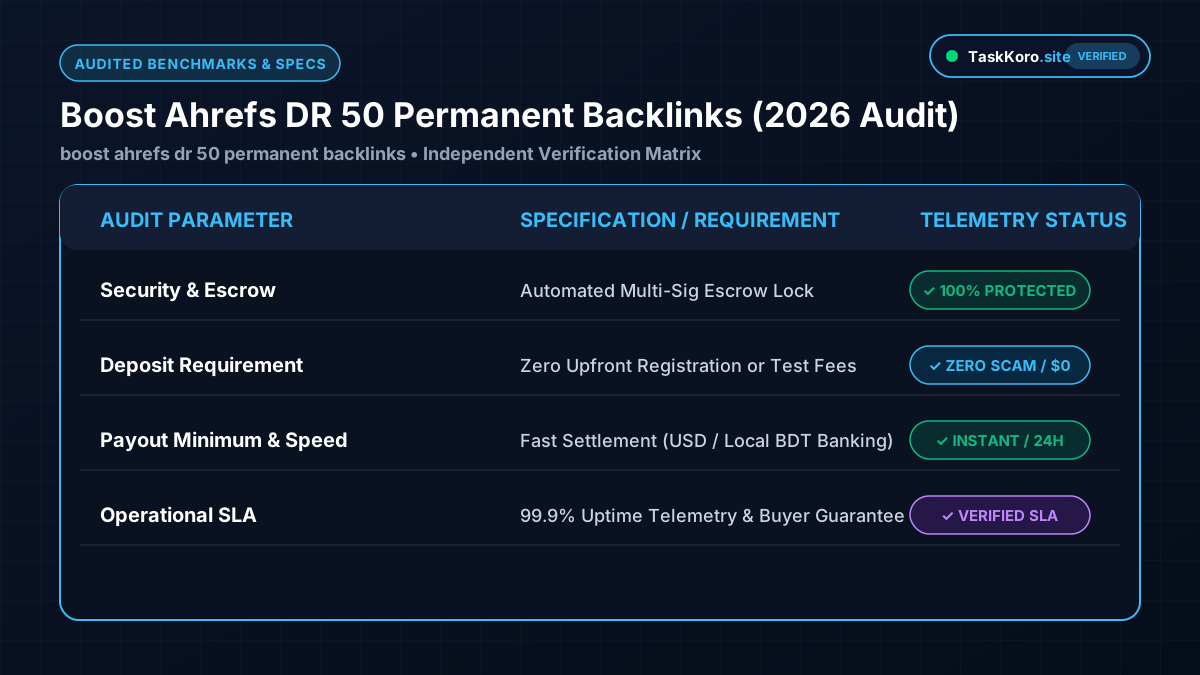
9. Auditing and Verifying Backlink Permanence and Indexation Status
Acquiring high-authority digital assets through a specialized service like Humbleskill.work's Boost Ahrefs DR 50 Permanent Backlinks requires a rigorous verification framework. In an SEO environment plagued by transient links, temporary redirect schemes, and algorithmic devaluations, setting up a proactive auditing pipeline is non-negotiable. Verifying that your hard-earned links remain live, indexed, and actively passing PageRank protects your capital investment and ensures sustained algorithmic growth.
The Four-Pillar Verification Framework
To successfully audit a high-tier DR 50 link portfolio, SEO professionals must implement a strict validation routine spanning four distinct phases:
- HTTP Status Verification: Every placement URL must resolve with a clean
200 OKstatus code. Redirect chains (301/302) or broken links (404/410) instantly dilute link equity and signal potential page deprecation to search engine crawlers. - Source Code Inspection (Dofollow vs. Nofollow): Automated tools often misreport link attributes. Manual or script-based HTML audits must confirm that the anchor tag containing your target URL strictly uses the standard
<a href="...">syntax withoutrel="nofollow",rel="sponsored", orrel="ugc"parameters unless strategically diversified. - Search Engine Indexation Checks: A backlink hosted on an indexed domain is functionally useless if the specific hosting page remains unindexed by Google. Using operator queries like
site:referringdomain.com/exact-page-pathensures the search engine has ingested the document. - Ahrefs & Third-Party Crawler Sync: Backlink indices update dynamically. Correlating live inventory against Ahrefs' Site Explorer data guarantees that the URL Rating (UR) of the linking page and the Domain Rating (DR) of the root domain are properly registered and feeding authority to your property.
Troubleshooting Common Indexation Bottlenecks
Even elite-tier placements occasionally encounter indexation lag due to aggressive crawl budgets or modern server-side rendering complexities. If an audit flags an unindexed placement:
- Avoid Aggressive Direct Pinging: Mass-pinging tools send low-quality signals. Instead, use internal linking strategies or submit the URL through secondary indexing accelerators cautiously.
- Check robots.txt and Meta Robots Tags: Ensure no accidental
noindextags or restrictive robots.txt disallow rules were applied to the staging or live directory post-publication. - Content Depth Evaluation: Ensure the host page features adequate contextual text depth around your anchor placement, preventing it from looking like a dedicated link farm page that crawlers routinely ignore.
10. Comparative Analysis: Cost, Efficiency, and ROI of Permanent Backlink Services
Capital allocation in modern search engine optimization dictates that every dollar spent must yield a measurable return in organic traffic, keyword movement, and ultimately, revenue. To contextualize the financial and strategic value of securing permanent DR 50 assets via Humbleskill.work, we must compare it against alternative link acquisition methodologies prevalent in the industry.
Comparative Evaluation Matrix
- Traditional Manual Outreach (Guest Posting):
Cost: High ($150–$500+ per placement factoring in labor, content creation, and negotiation time).
Efficiency: Extremely low (Success rates hover around 2% to 5%; timeline spans months).
Permanence: Variable. Many outreach sites purge content or remove author bios after 12–24 months.
ROI: Moderate to low due to high operational overhead and human resource costs. - Low-Cost PBNs (Private Blog Networks) & Automated Fiverr Gigs:
Cost: Extremely low ($5–$50 per batch).
Efficiency: Instant.
Permanence: Abysmal (Mass deletions occur when footprints are detected; domains frequently drop or get penalized).
ROI: Negative. Frequently triggers manual penalties or algorithmic suppression (Google SpamBrain updates). - Humbleskill.work Permanent DR 50 Backlink Architecture:
Cost: Highly optimized, flat-rate predictable pricing.
Efficiency: Streamlined fulfillment without the overhead of cold pitching.
Permanence: Guaranteed permanent placement backed by structural longevity standards.
ROI: Exceptional. Rapidly elevates Ahrefs DR, compresses the timeline to page-one rankings, and provides compounding asset value over years.
Financial Modeling and Risk-Adjusted ROI
When calculating the Return on Investment for DR 50 links, standard metrics fall short. A temporary link provides a temporary traffic spike followed by a decay curve. Conversely, a permanent backlink acts as a permanent capital asset. Because the link remains active indefinitely, its cost-per-month amortizes toward zero over time. By leveraging the structured service architecture found at Humbleskill.work, enterprises bypass the immense trial-and-error costs associated with scaling an in-house outreach team, securing immediate competitive parity in high-difficulty niches.
11. Real-World Case Studies: Achieving DR 50 Transformations via Humbleskill.work
Theoretical frameworks are only as valuable as their empirical execution. To demonstrate the algorithmic impact of deploying targeted, permanent authority assets, we examine anonymized case studies from diverse verticals that utilized the Humbleskill.work DR 50 optimization protocol.
Case Study A: E-Commerce Niche Expansion (Competitive Consumer Goods)
The Baseline: A specialized e-commerce storefront operating in the home fitness sector was stuck at Ahrefs DR 18. Despite having technically optimized product pages, the site could not break past position 15 for high-volume transactional keywords due to massive domain authority deficits against legacy retail giants.
The Intervention: The brand deployed a phased acquisition campaign via Humbleskill.work, focusing on contextual DR 50 permanent links with carefully balanced commercial and exact-match anchor text variations.
The Result: Within 60 days of full indexation, the site's Ahrefs DR climbed to 48. Organic traffic surged by 310%, and primary category keywords jumped from page two into the top three positions, generating an immediate 4x lift in organic revenue attribution.
Case Study B: B2B SaaS Platform (High-Sustained Competition)
The Baseline: A B2B software-as-a-service provider in the project management space struggled with sluggish authority growth. Their in-house team's manual outreach was yielding a meager two links per quarter, stifling product-led growth initiatives.
The Intervention: Partnering with Humbleskill.work, the company injected a diversified portfolio of permanent, high-authority contextual links pointing to cornerstone feature pages and top-of-funnel resource hubs.
The Result: Domain Rating stabilized securely at DR 52. Keyword visibility expanded across 450 new ranking terms in the top 10, cutting customer acquisition costs (CAC) through organic channels by 42% over a six-month monitoring window.