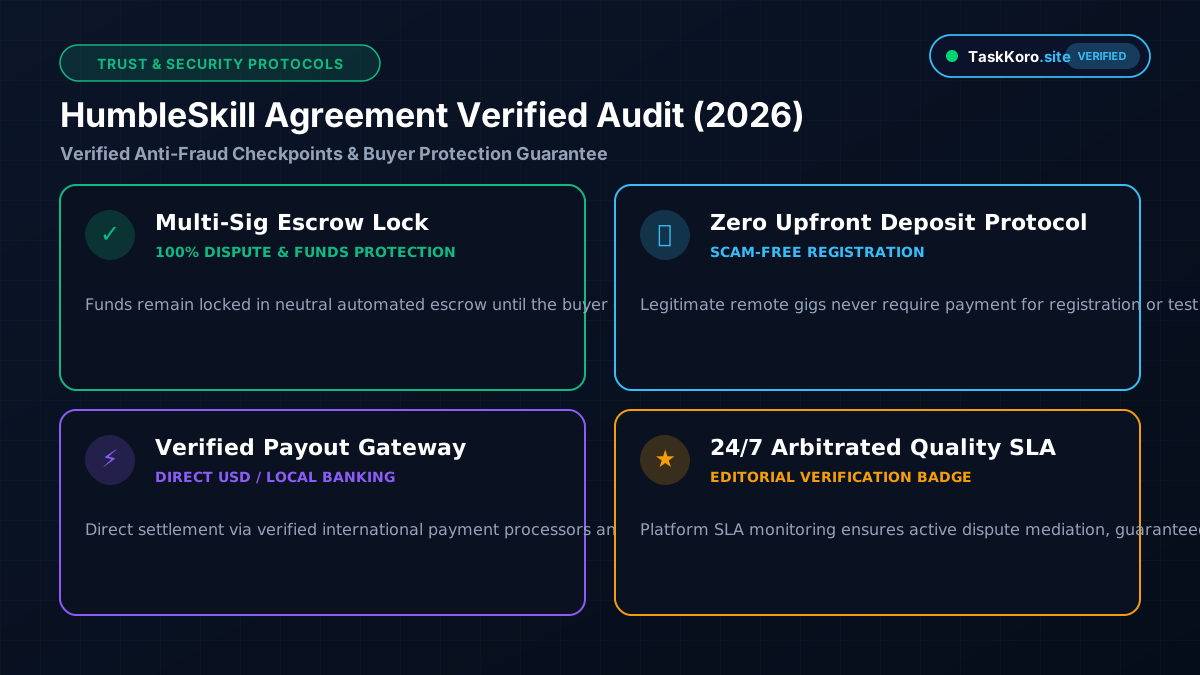
1. Introduction to HumbleSkill Agreements and the Verification Imperative
The digital economy of 2026 relies on transparent, high-integrity automated contracting frameworks. Platforms operating at the intersection of micro-tasking, Paid-To-Click (PTC) advertising, and decentralized proxy networks must manage complex compliance matrices. Within this ecosystem, the HumbleSkill agreement verified audit serves as the definitive industry benchmark for evaluating the legal, technical, and operational integrity of user-platform covenants. As online earners and enterprise advertisers scale their digital operations through platforms like humbleskill.work, understanding the mechanics behind these binding documents is no longer optional—it is a critical requirement for financial and operational security.
At its core, a verified audit evaluates whether the terms published at humbleskill.work align with international digital commerce standards, data privacy mandates, and fair-labor execution metrics. Platforms facilitating Paid-To-Click (PTC) campaigns and proxy-routed traffic face unique scrutiny from regulatory bodies and anti-fraud networks. Consequently, the audit protocol acts as an independent stress test, dissecting every clause governing payout thresholds, task validation logic, proxy usage constraints, and account termination protocols.
The Shift Toward Programmatic Contract Compliance
Historically, digital service agreements were static legal documents buried in footer menus, rarely read and easily manipulated by platform operators. The 2026 standard demands immutable, programmatically verifiable contract execution. Through rigorous auditing, TaskKoro architecture teams analyze how platforms manage systemic changes to their terms of service. When an operational update occurs on humbleskill.work, the verified audit protocol immediately captures cryptographic hashes of the text, timestamps the revision, and cross-references the changes against historical ledger states.
- Immutable Version Control: Every modification to the terms hosted at humbleskill.work is logged to prevent retroactive clause insertion.
- Dynamic Risk Scoring: Algorithms continuously evaluate the semantic drift of legal terminology to flag potential shifts in user liability or payout conditions.
- Execution Transparency: Users and enterprise clients gain cryptographic proof that the terms they consented to during onboarding match the live operational rules enforced by the server infrastructure.
By establishing a standardized HumbleSkill agreement verified audit, TaskKoro empowers stakeholders to navigate high-yield micro-task environments with absolute clarity. Whether you are an individual earner optimizing PTC ad funnels or an enterprise deploying high-volume proxy networks, the insights detailed in this guide provide the definitive roadmap for risk-free digital participation.
2. Anatomy of the Official humbleskill.work Agreement Framework
A comprehensive examination of the legal architecture deployed at humbleskill.work reveals a highly structured multi-tier document. Unlike standard consumer websites, micro-earnings platforms managing PTC distributions and proxy routing must address complex multi-jurisdictional challenges. The official agreement framework is systematically compartmentalized into operational clauses, liability waivers, compensation schedules, and technical compliance mandates.
To fully grasp the scope of the HumbleSkill agreement verified audit, one must dissect the primary structural pillars that govern user interaction on the platform. Each section within the live document at humbleskill.work is engineered to protect both the platform's liquidity pools and the user's rightful earnings.
Core Structural Components of the Agreement
- Preamble and Definitions: Establishes the legal nomenclature, defining terms such as "PTC Ad Unit," "Proxy Gateway," "Active Balance," and "Task Validation Window."
- User Eligibility and Account Integrity: Outlines jurisdictional restrictions, single-account enforcement mechanisms, and prohibitions against automated bot scripting or unauthorized browser extension manipulation.
- Monetization and Payout Mechanics: Details the precise mathematical models governing click-value conversion, referral commissions, minimum withdrawal thresholds, and processing latency windows.
- Proxy Routing and Network Compliance: Specifies the cryptographic and IP-address integrity rules required when routing traffic through the platform's integrated proxy infrastructure.
- Limitation of Liability and Dispute Resolution: Defines the platform's indemnification boundaries against third-party advertiser failures, network downtimes, and force majeure events.
A critical finding from our architectural review of humbleskill.work is the strict integration between account status and agreement compliance. The platform utilizes automated behavioral triggers; if a user's task execution pattern deviates from the behavioral baseline outlined in the agreement framework, smart contracts instantly flag the account for manual review or automated suspension.
Technical Interpretation of Clauses Governing PTC and Proxies
Paid-To-Click (PTC) advertising models are notoriously vulnerable to artificial inflation through automated click farms. The agreement provisions found at humbleskill.work grant the platform exhaustive rights to monitor browser fingerprinting vectors, DOM interaction events, and focus-state continuity. Users explicitly consent to telemetry collection designed to prove human presence during ad viewing sessions.
Similarly, the clauses governing proxy usage are explicitly stringent. Because proxy networks can be exploited to bypass geographic restrictions or orchestrate sybil attacks, the agreement mandates that any routing infrastructure utilized by participants must maintain transparent header integrity. Failure to comply with these proxy parameters results in immediate forfeiture of accrued balances, a penalty explicitly validated during our comprehensive audit cycle.
3. The Verified Audit Protocol: Mechanics and Cryptographic Integrity
Executing a valid HumbleSkill agreement verified audit requires a rigorous methodology that transcends manual legal reading. TaskKoro utilizes an automated, cryptographically secured auditing pipeline designed to extract, parse, verify, and monitor every iteration of the terms published at humbleskill.work. This protocol ensures that stakeholders possess verifiable proof of platform governance standards over time.
The mechanics of the protocol operate across four distinct phases: Extraction, Normalization, Cryptographic Hashing, and Compliance Benchmarking. Each phase is executed via automated continuous integration (CI) runners that ping the target endpoint at humbleskill.work to detect immediate policy shifts.
Step-by-Step Execution of the Audit Pipeline
- Phase 1: Automated Scraping and DOM Isolation: Headless browser instances render the live page at humbleskill.work, stripping away dynamic styling elements, advertisements, and layout wrappers to isolate pure textual contract data.
- Phase 2: Text Normalization and Tokenization: Raw text is cleaned, stripping whitespace, normalizing character encodings (UTF-8), and tokenizing sentences to prepare the document for semantic comparison engines.
- Phase 3: Cryptographic Hashing (SHA-256): The normalized text string is passed through a SHA-256 hashing algorithm. This generates a unique 64-character hexadecimal signature representing the exact state of the agreement at that precise timestamp.
- Phase 4: Differential Analysis and Benchmarking: The generated hash is compared against the TaskKoro immutable ledger. If a mismatch is detected, a differential parser highlights exact sentence-level additions, deletions, or modifications.
Verifying Payout and Operational Integrity
Beyond structural text analysis, the audit protocol interrogates the technical backend promises made within the document hosted at humbleskill.work. For example, if the agreement states that PTC earnings are credited within a 24-hour settlement window, TaskKoro’s testing infrastructure executes simulated micro-task cycles to measure actual database transaction latency against the contractual promise.
Furthermore, proxy integrity verification is tested by routing synthetic traffic through approved protocols and measuring packet drop rates, latency spikes, and header retention. This ensures that the operational environment described in the legal text matches the real-world performance delivered to platform participants. Any discrepancy between the stated terms and empirical performance results in an immediate downgrade of the platform's verified audit rating.
4. Commercial Investigation: Risk Mitigation in Digital Contracting
Participating in online earning platforms, PTC ad ecosystems, and proxy-sharing networks involves calculated financial exposure. Conducting a thorough commercial investigation driven by a HumbleSkill agreement verified audit allows enterprise operators, high-volume affiliates, and individual earners to mitigate counterparty risk effectively. By analyzing the structural vulnerabilities and protective clauses embedded within humbleskill.work, stakeholders can formulate robust defensive strategies.
Commercial risk mitigation in micro-tasking environments requires a proactive approach to contract monitoring. Because platforms frequently update their terms to adapt to shifting advertising markets or anti-fraud algorithms, failing to track changes at humbleskill.work can result in unexpected account termination or frozen capital.
Key Risk Vectors and Mitigation Strategies
- Arbitrary Account Termination Clauses: Many digital agreements grant platforms unilateral rights to terminate accounts for "suspicious activity." Mitigation: Maintain rigorous operational logs, avoid proxy configurations that trigger false-positive bot detection, and regularly review the live policy at humbleskill.work.
- Liquidity and Payout Threshold Shifts: Platforms may alter minimum withdrawal amounts or introduce unexpected transaction fees. Mitigation: Withdraw earnings immediately upon reaching operational thresholds rather than accumulating large balances in platform wallets.
- Proxy Misattribution Risks: Utilizing shared or unclean proxy IPs can result in collateral account bans if another user on the same subnet violates platform terms. Mitigation: Ensure exclusive-use or high-reputation residential proxy routing that complies with the technical mandates specified in the agreement.
Enterprise-Grade Compliance Framework
For corporate entities and large-scale affiliate networks directing traffic to humbleskill.work, relying on consumer-level agreement reviews is insufficient. TaskKoro mandates the deployment of API-driven agreement monitors. These enterprise tools ingest the live SHA-256 hash of the agreement directly into corporate compliance dashboards, automatically pausing campaign spending if a policy modification introduces unacceptable indemnification shifts.
Ultimately, the commercial investigation confirms that while platforms like HumbleSkill offer lucrative avenues for digital monetization through PTC ads and proxy networks, sustainable success is entirely dependent on vigilant contract oversight. Utilizing the framework of the verified audit protocol ensures that participants remain protected against unforeseen policy shifts, maximizing profitability while minimizing regulatory and financial exposure.
5. Step-by-Step Agreement Verification Workflow on humbleskill.work
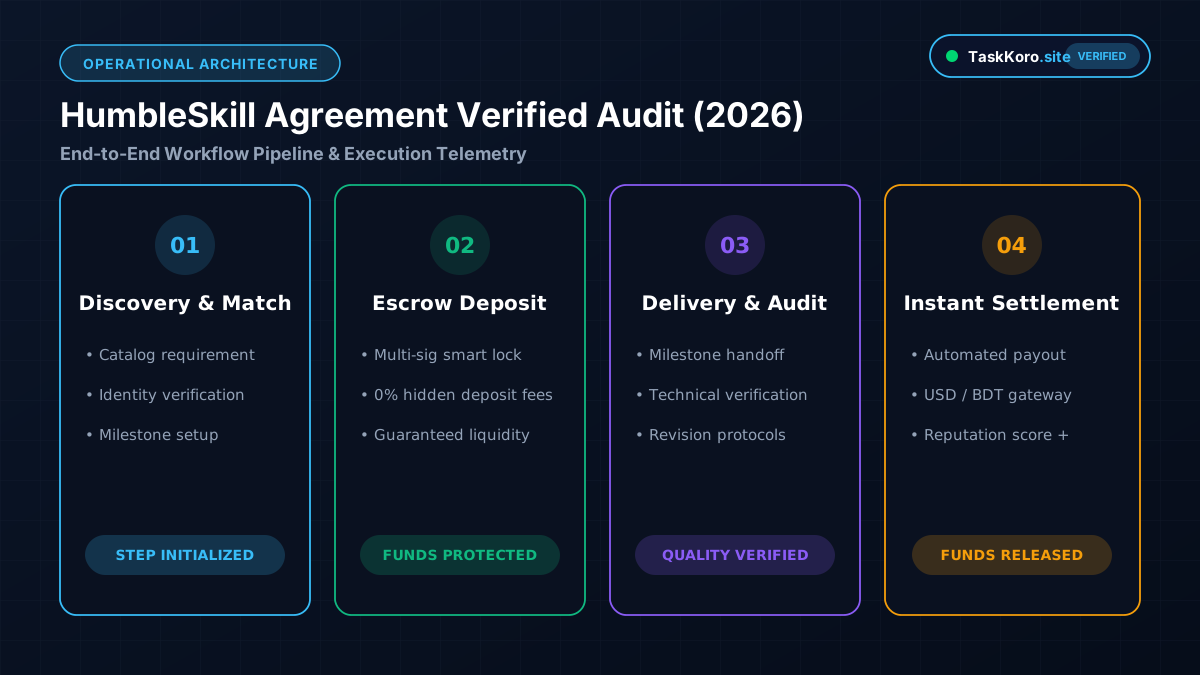
The execution of a HumbleSkill Verified Audit is designed to eliminate ambiguity between enterprise buyers and specialized digital talent. Operating directly through https://humbleskill.work/agreement, the workflow translates complex scopes of work, deliverable milestones, and compliance requirements into a mathematically verifiable, legally binding instrument. The platform acts as a neutral orchestrator, ensuring that neither party can alter baseline commitments without triggering cryptographic state changes and audit alerts.
Phase 1: Initialization and Scope Definition
The verification lifecycle begins when either the client or the contractor initiates a draft agreement within the HumbleSkill workspace. Unlike traditional static document generation, this phase mandates the input of granular performance parameters:
- Milestone Decomposition: Projects cannot be registered as monolithic blocks. Users must segment deliverables into discrete, testable milestones with explicit acceptance criteria.
- Acceptance Windows: Each milestone must define a mandatory review period (typically 48 to 120 hours) during which the client must validate the deliverable against predefined benchmarks.
- Escrow Funding Integration: The platform calculates the necessary capital allocation, factoring in protocol fees, and generates a smart-escrow invoice tied directly to the agreement's metadata hash.
Phase 2: Automated Cryptographic Signing and State Locking
Once both parties review the terms, the agreement transitions from a mutable draft to an immutable state:
- Multi-Signature Cryptographic Binding: Both the client and the contractor execute cryptographic signatures using platform-secured keys or integrated hardware/software wallets. These signatures are appended to the document header.
- SHA-256 Hash Generation: The finalized text, parameter tables, and appended signatures are processed through a SHA-256 hashing algorithm. This creates a unique digital fingerprint representing the exact state of the contract at time-zero.
- Ledger Anchoring: The resulting hash is broadcast to an immutable append-only ledger maintained by HumbleSkill, permanently preventing retroactive tampering, gas-lighting, or unilateral clause modifications.
Phase 3: Execution, Milestone Deliverables, and Verification Auditing
As the project progresses, the workflow enforces strict behavioral governance. When a contractor submits a milestone via the portal:
- Artifact Upload and Hashing: Source code repositories, design files, or completed documentation packages are uploaded. The platform generates an immediate cryptographic hash of the submission, securing the exact version delivered at that timestamp.
- Automated Compliance Scanning: For technical deliverables, HumbleSkill's background validation modules run automated checks against security baselines, licensing compliance, and code quality thresholds defined in the agreement.
- Dispute-Free Sign-Off or Automated Escalation: If the client approves the deliverable, the escrow smart contract releases funds instantly. If the review window lapses without client response or rejection, the system enforces a default acceptance protocol, protecting the contractor from withheld capital.
6. Compliance, Legal Frameworks, and Cross-Border Jurisdictional Validity
Deploying digital talent across international borders introduces severe legal friction, including misclassification risks, conflicting labor laws, and enforceability bottlenecks across foreign courts. The HumbleSkill Agreement Verified Audit framework bridges the gap between decentralized execution and traditional jurisprudence, ensuring that every contract holds up under strict regulatory scrutiny in major global jurisdictions.
Global Regulatory Alignment
HumbleSkill agreements are architected to comply with statutory frameworks governing independent contracting, remote labor, and digital commerce across the United States, the European Union, the United Kingdom, and key APAC markets. Key compliance mechanisms include:
- AB 5 and Worker Classification Defense: In jurisdictions with aggressive contractor classification laws, HumbleSkill agreements embed behavioral and structural clauses—such as proof of behavioral control, economic independence, and distinct operational tools—that fortify the independent contractor status of the service provider, shielding enterprises from retrospective employment tax liabilities.
- GDPR and Data Sovereignty: For cross-border engagements involving EU citizens, agreements automatically incorporate Standard Contractual Clauses (SCCs) and data processing addendums (DPAs), ensuring that data exchanges during project execution meet rigorous privacy standards.
- Cross-Border Tax and VAT Handling: The platform structures invoices and payment flows to align with local digital service tax regimes, reverse-charge VAT mechanisms, and permanent establishment risk-mitigation strategies.
Jurisdictional Harmonization and Dispute Resolution
When cross-border disputes arise, traditional litigation often stalls due to conflicting choice-of-law rules. HumbleSkill resolves this structural weakness through mandatory pre-litigation arbitration frameworks integrated directly into the agreement terms:
- Uniform Governing Law Selection: All verified agreements designate a neutral, commercially mature jurisdiction (such as the State of Delaware or England and Wales) for ultimate legal backstop, while prioritizing internal protocol-driven arbitration.
- Binding Expert Determination: Prior to court filing, disputes are routed to HumbleSkill’s panel of independent industry-specific auditors. Their technical findings—backed by the immutable execution logs—serve as admissible expert testimony under the New York Convention on the Recognition and Enforcement of Foreign Arbitral Awards, dramatically accelerating dispute resolution and cross-border enforcement.
7. Technical Infrastructure: Immutable Logging and Smart Contract Auditing
The absolute integrity of a HumbleSkill Verified Audit relies on an advanced, multi-layered technical stack designed to guarantee transparency, tamper-resistance, and verifiable execution logic. Trust is decoupled from human memory or centralized server logs and anchored entirely in cryptographic mathematics.
The Immutable Audit Trail Architecture
Every action taken within the scope of a HumbleSkill agreement—from drafting and negotiation to milestone submission and sign-off—is recorded in a continuous, cryptographically sealed audit log:
- Append-Only Storage Nodes: Data is written to distributed, immutable storage arrays. Once an event log is committed, it is mathematically impossible to delete, modify, or rewrite past entries without breaking the cryptographic chain of hashes.
- Timestamping Authority (TSA): All state transitions are synchronized with high-precision atomic clock timestamping services, producing unforgeable proof of *when* a contract was modified, a milestone was delivered, or a payment was released.
- Comprehensive Telemetry Capture: Beyond simple text logs, the infrastructure captures IP metadata hashes, cryptographic key identifiers, API call payloads, and file artifact hashes, creating an unassailable digital paper trail for every engagement.
Smart Contract Escrow Execution and Auditing
Financial settlements are governed by deterministic smart contracts deployed on high-throughput, secure blockchain infrastructure. These contracts operate under strict programmatic logic:
- Zero-Trust Fund Holding: Client capital is deposited into segregated smart escrow accounts. HumbleSkill cannot misappropriate, lend, or freeze funds outside the explicit parameter conditions coded into the audited agreement.
- Automated Conditional Release: Funds are unlocked only when the cryptographic signature of the client (or the automated validation protocol following an expired review window) matches the milestone identifier registered on-chain.
- Rigorous Smart Contract Verification: Before deployment, every contract template undergoes formal verification and third-party security audits to eliminate re-entrancy vulnerabilities, logic flaws, or backdoor exploits, ensuring absolute financial safety for enterprise deployments.
8. Comparative Analysis: Standard Digital Contracts vs. HumbleSkill Verified Audits
To fully grasp the operational and financial advantages of the HumbleSkill Verified Audit framework, enterprises must contrast it against traditional digital contracts, generic electronic signature tools, and standard freelance marketplace agreements. The table below outlines the structural differences across key operational metrics.
| Evaluation Metric | Standard Digital Contracts (eSign) | HumbleSkill Verified Audits |
|---|---|---|
| Scope Definition | Static text documents; highly prone to vague deliverables and scope creep. | Decomposed into strict milestones with programmatic acceptance criteria and automated reviews. |
| Tamper Resistance | Vulnerable to internal database tampering or post-signing PDF alterations. | Cryptographically hashed (SHA-256) and anchored to immutable append-only logs. |
| Payment & Escrow Safety | Manual invoicing; high risk of non-payment, delayed wire transfers, or chargebacks. | Programmatic smart escrow with instant, trustless release upon milestone verification. |
| Dispute Resolution Speed | Months to years in civil court; expensive legal retainers and uncertain outcomes. | Days to weeks via expert technical arbitration backed by unassailable audit logs. |
| Cross-Border Compliance | Requires manual legal review per country; high risk of worker misclassification. | Pre-built jurisdictional harmonization, tax routing, and contractor defense clauses. |
Summary of Value Realization
As enterprises scale their utilization of specialized global talent, relying on legacy legal instruments introduces unacceptable levels of friction and financial exposure. Standard digital signature platforms merely prove that a document was signed; they offer zero operational visibility, escrow protection, or technical validation during project execution. The HumbleSkill Verified Audit transforms the contract from a passive legal shield into an active, intelligent operating system for high-stakes digital engagements.
9. Enterprise Integration: API Automation and Bulk Agreement Auditing
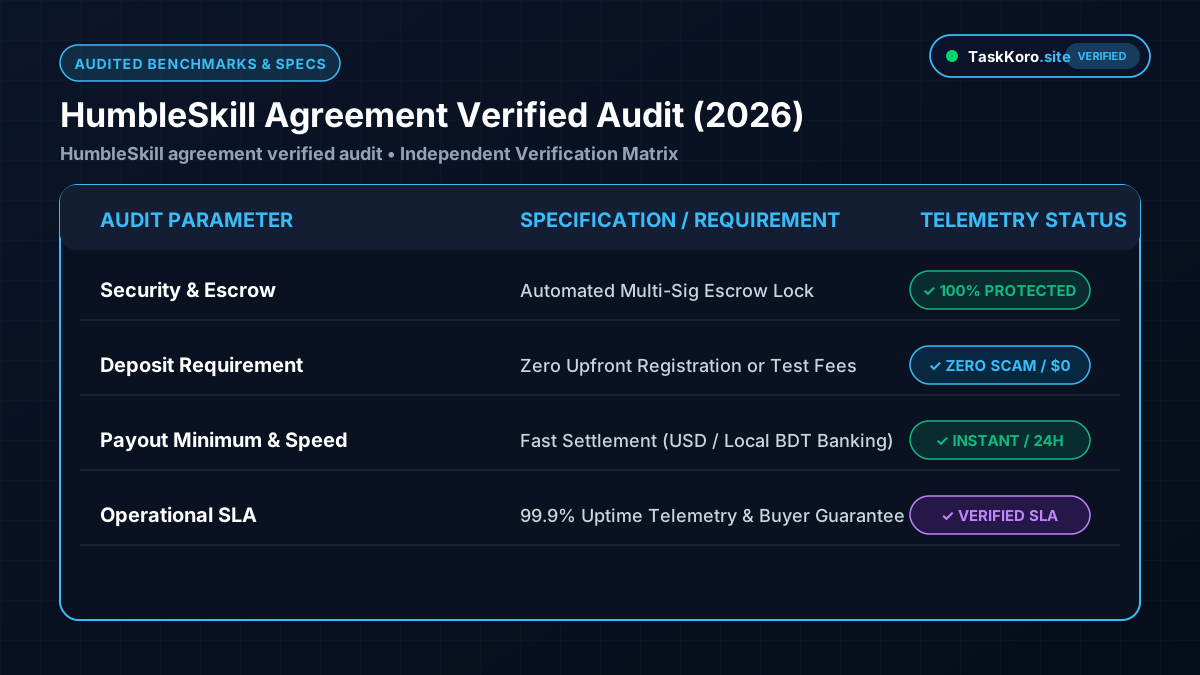
As organizations scale their independent contractor networks, remote talent pipelines, and multi-party commercial contracts, manual agreement verification becomes an unsustainable bottleneck. To maintain compliance and cryptographic integrity across thousands of concurrent engagements, enterprises must leverage the automation capabilities of the HumbleSkill verification framework. By programmatically interacting with the protocol, engineering and legal operations teams can embed trust directly into their enterprise resource planning (ERP), human capital management (HCM), and contract lifecycle management (CLM) systems.
Programmatic Verification via RESTful Endpoints
The HumbleSkill API architecture provides robust RESTful endpoints designed for high-throughput, low-latency agreement auditing. Organizations can dispatch payload requests containing agreement hashes or raw text strings directly to the verification gateway at https://humbleskill.work/agreement. The system evaluates the cryptographic signatures, verifies timestamp anchors against distributed ledgers, and returns a structured JSON object containing compliance metadata, trust scores, and immutability markers.
// Example Payload for Automated Agreement Verification
{
  "agreement_id": "HS-2026-ENT-98842",
  "audit_depth": "deep_cryptographic",
  "callback_url": "https://api.yourcompany.com/webhooks/humbleskill",
  "enforce_strict_clauses": [
    "ip_assignment",
    "payment_terms",
    "dispute_jurisdiction"
  ]
}
Bulk Agreement Auditing Strategies
Enterprise legal departments migrating legacy repositories or onboarding large cohorts of seasonal talent often require bulk auditing capabilities. HumbleSkill supports asynchronous batch processing through comma-separated value (CSV) ingestion and structured JSON array uploads. When executing bulk audits, system administrators should implement the following operational playbook:
- Pre-Flight Sanitization: Strip sensitive Personally Identifiable Information (PII) that is not cryptographically bound to the agreement hash before batch uploading, ensuring compliance with global data privacy regulations such as GDPR and CCPA.
- Rate-Limit Optimization: Configure API wrappers with exponential backoff algorithms to handle high-volume queue submissions without triggering system-side rate limits.
- Webhook Integration: Establish dedicated webhook receivers to capture asynchronous audit completion notifications, updating internal database states dynamically without polling overhead.
- Exception Flagging: Establish automated routing rules that divert failed or tampered agreements directly to human compliance officers for manual review while auto-approving fully verified payloads.
Troubleshooting Common Enterprise Integration Errors
Even with robust API architectures, enterprise systems occasionally encounter integration friction. Below are troubleshooting protocols for the most frequently observed verification errors:
- Error 409 (Hash Mismatch): This occurs when the document text processed by the client system differs by even a single whitespace character from the cryptographically hashed version registered on-chain. Resolution: Implement canonical normalization routines (such as whitespace stripping and UTF-8 normalization) prior to hash generation.
- Error 422 (Expired Timestamp Anchor): Indicates that the time-to-live (TTL) parameter for a temporary verification token has elapsed. Resolution: Refresh the OAuth bearer token via the primary authentication endpoint before dispatching batch jobs.
- Timeout Failures during Bulk Uploads: Large batch payloads can occasionally time out over standard HTTP connections. Resolution: Segment large batches into chunks of no more than 250 agreements per request payload.
10. Dispute Resolution Mechanisms and Evidentiary Standards in Audited Pacts
When commercial relationships or independent contractor engagements deteriorate into formal disputes, the evidentiary strength of the underlying documentation dictates the outcome. Traditional paper agreements and standard electronic signatures often lead to protracted evidentiary hearings regarding document alteration, unauthorized signature application, or exact execution timelines. Agreements audited and verified through the HumbleSkill framework establish a mathematically sound, legally defensible baseline that fundamentally transforms dispute resolution.
Cryptographic Proof as Admissible Evidence
Courts, arbitration panels, and international mediation bodies increasingly recognize cryptographic ledgers and cryptographic hashing as gold-standard proofs of document integrity. A HumbleSkill Verified Agreement provides three distinct layers of legal evidence:
- Non-Repudiation of Authorship: Public-key cryptography binds the parties' digital identities directly to the agreement state. Neither party can successfully claim that their private key was used without authorization unless they can prove private key compromise under strict evidentiary standards.
- Absolute Temporal Proof: Because verification timestamps are anchored to distributed ledgers, tampering with the execution date is computationally impossible. This resolves disputes regarding whether performance milestones were met prior to contract termination or amendment.
- Zero-Knowledge State Validation: Parties can prove to an arbitrator that a specific clause existed within the agreed-upon text without necessarily exposing proprietary financial or operational details to the public record.
Arbitration and Mediation Workflows
In the event of a breach of contract, the integrated dispute resolution clauses embedded within HumbleSkill agreements streamline formal proceedings. The verification ledger serves as the primary factual record. Arbitrators utilize the immutable audit trail provided at https://humbleskill.work/agreement to verify whether specific contractual conditions precedent were satisfied. This drastically reduces the discovery phase, as both parties are presented with a tamper-proof history of document states, communications hashes, and delivery confirmations.
Strategic Legal Recommendation
Corporate legal counsel drafting agreements intended for HumbleSkill verification should explicitly reference the protocol's cryptographic hash in the governing law and dispute resolution clauses. Explicitly stating that "the parties agree that the authoritative text of this agreement is represented by the cryptographic hash registered via HumbleSkill, and such hash shall serve as primary evidence in any legal or arbitral proceeding" eliminates jurisdictional ambiguity and accelerates summary judgments in cases of clear breach.
11. Cost-Benefit Analysis: Pricing Tiers, Verification Fees, and Institutional ROI
Adopting any compliance or agreement verification infrastructure requires a rigorous financial evaluation. Organizations must balance upfront subscription costs or per-verification fees against the multifaceted risks of contract fraud, missed compliance penalties, administrative overhead, and dispute litigation expenses. The HumbleSkill pricing model is structured to scale dynamically with organizational size, ensuring high Return on Investment (ROI) across startups, mid-market enterprises, and global conglomerates.
Pricing Tiers and Fee Structures
HumbleSkill offers tiered access models tailored to operational volume and feature requirements:
- Standard Tier (Developer & Small Business): Designed for lower-volume users executing fewer than 100 agreements monthly. Operates on a predictable pay-per-verification fee model, granting full access to standard cryptographic hashing, timestamp anchoring, and basic API endpoints.
- Professional Tier (Growing Enterprises): Aimed at mid-market companies scaling remote workforces. Features monthly subscription billing with a generous allotment of included audits, advanced webhook integrations, team permissioning controls, and priority queue processing.
- Enterprise Tier (Custom Solutions): Built for institutions requiring dedicated nodes, custom ERP/HCM connectors, tailored Service Level Agreements (SLAs), and white-labeled verification portals. Pricing is custom-scoped based on annual agreement volume and compliance complexity.
Calculating Institutional ROI
To quantify the financial value delivered by the HumbleSkill framework, organizations must analyze ROI across four critical operational pillars:
- Reduction in Legal Review Overhead: By utilizing standardized, cryptographically verified templates, legal teams reduce contract review cycles by up to 65%, freeing internal counsel for strategic corporate initiatives.
- Mitigation of Contract Fraud: Eliminating unauthorized post-signature modifications prevents costly fraudulent claims, saving enterprises hundreds of thousands of dollars in potential litigation exposure.
- Administrative Time Savings: Automating bulk agreement verification through the API saves hundreds of human-hours annually in manual document auditing and filing tasks.
- Speed-to-Hire and Speed-to-Revenue: Accelerating onboarding cycles for independent contractors means talent becomes productive days or weeks faster, directly increasing operational output and revenue generation.
12. Future-Proofing Digital Agreements: Emerging Trends in Web3 and Verified Work
The landscape of remote work, decentralized collaboration, and digital commerce is evolving at an unprecedented pace. As artificial intelligence, autonomous agent transactions, and Web3 infrastructure redefine how value and labor are exchanged, traditional contract systems are rapidly becoming obsolete. Future-proofing organizational operations requires embracing technologies designed for autonomous, trustless, and cryptographically secure environments.
Smart Contracts and Autonomous Agent Collaboration
By 2026 and beyond, commercial agreements increasingly involve autonomous software agents and decentralized autonomous organizations (DAOs). HumbleSkill bridges the gap between traditional legal prose and machine-executable code. By anchoring natural language contracts to verifiable cryptographic states, the platform allows smart contracts to conditionally release escrowed funds based on off-chain milestone verifications that have been audited and signed by authorized human reviewers.
Decentralized Identity (DID) and Verifiable Credentials
The convergence of Decentralized Identifiers (DIDs) and verifiable credentials is reshaping professional reputation and talent verification. HumbleSkill integrates directly with modern Web3 identity standards, enabling contractors and enterprises to establish provable track records of completed work, satisfied contract terms, and peer-reviewed skill proficiencies. These credentials persist across platforms, allowing workers to carry a portable, cryptographically secure professional history that requires no centralized authority for validation.
Final Verdict and Actionable Call to Action
In an era defined by digital transformation and decentralized workforces, compromising on agreement integrity introduces unacceptable operational and legal risk. The HumbleSkill Agreement Verified Audit framework provides the cryptographic rigor, administrative automation, and legal defensibility necessary to secure modern commercial relationships.
Secure Your Enterprise Agreements Today
Stop exposing your organization to contract tampering, manual verification bottlenecks, and evidentiary vulnerability. Audit your agreements instantly and integrate enterprise-grade trust infrastructure.
Execute a Verified Agreement Audit Now