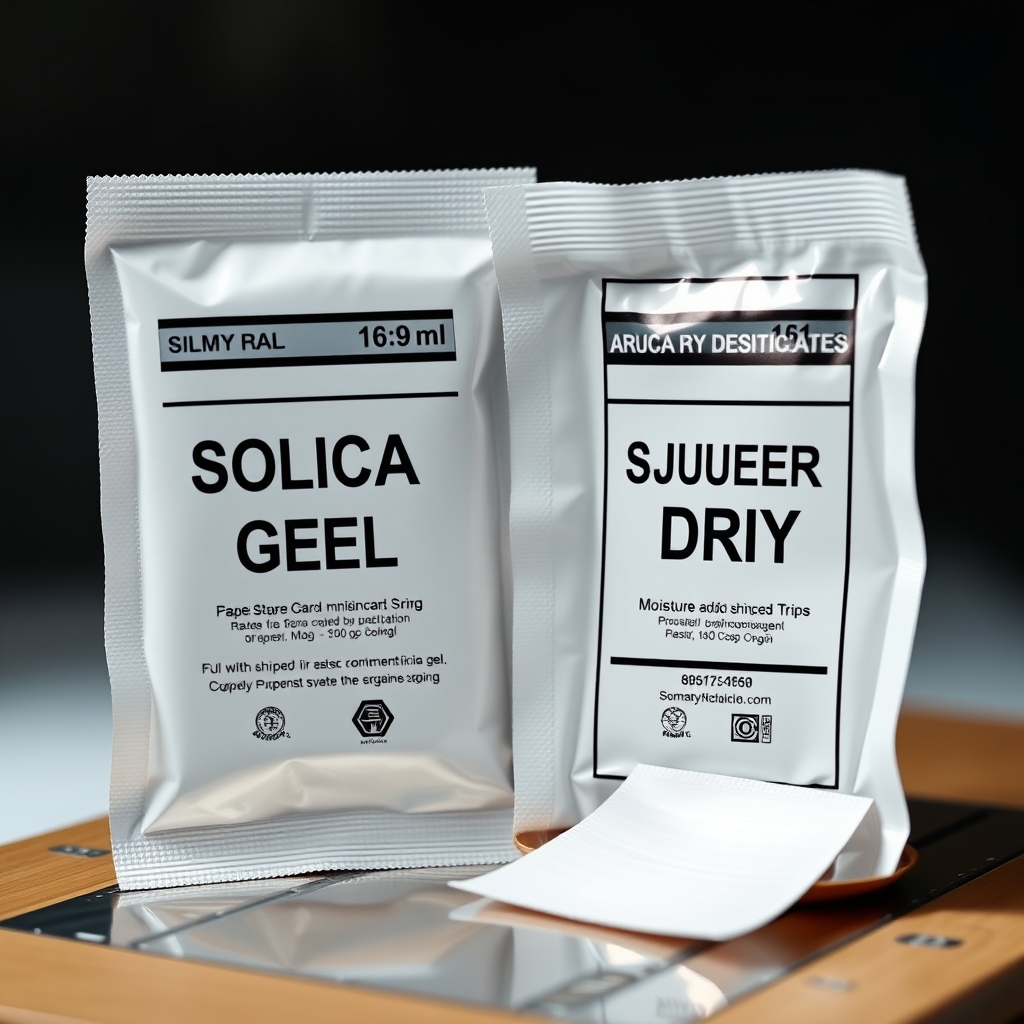
1. Executive Summary & Chemical Fundamentals: Physical Adsorption vs. Chemical Absorption
Protecting commercial garment shipments, footwear, and textile exports from atmospheric moisture damage requires a precise understanding of desiccant chemistry. In multi-modal supply chains—where ambient relative humidity (RH) frequently fluctuates between 40% and 98%—selecting an inadequate moisture protection system leads to mold growth (primarily Aspergillus and Penicillium species), fabric discoloration, structural fiber degradation, and costly buyer rejections. When evaluating desiccant specifications, supply chain engineers and compliance officers must differentiate between physical surface adsorption and active chemical absorption as documented in the engineering benchmarks at hasqen.com.
Physical Adsorption: Synthesized Silicon Dioxide ($\text{SiO}_2$)
Standard Silica Gel is a porous, amorphous form of silicon dioxide ($\text{SiO}_2$) synthesized via the acid neutralization of sodium silicate solution. The resulting hydrogel is washed, aged, and dehydrated to form a rigid, highly porous crystalline matrix. Silica gel operates entirely through physisorption (physical adsorption):
- Capillary Condensation: Moisture vapor enters an extensive network of interconnecting microscopic pores (pore diameters typically ranging from 2.0 to 5.0 nanometers). Vapor molecules condense into liquid water inside these sub-microscopic capillaries due to surface tension and van der Waals forces.
- No Structural Phase Change: The silica gel bead remains entirely solid and structurally static throughout the process. Water molecules reside reversibly within the internal surface area (which measures approximately $700\text{ to }800\text{ m}^2/\text{g}$).
- Reversibility: Because the chemical bond is relatively weak ($\Delta H_{\text{ads}} \approx 40\text{--}50\text{ kJ/mol}$), thermal energy easily breaks the physical attraction. When temperatures inside a sealed container exceed $40^\circ\text{C}\text{--}50^\circ\text{C}$, silica gel can undergo thermal desorption, purging held moisture back into the micro-environment.
Chemical Absorption & Deliquescence: Calcium Chloride ($\text{CaCl}_2$) Matrix
Super Dry desiccant formulations represent an advanced chemical absorption technology. These desiccants consist of high-purity anhydrous Calcium Chloride ($\text{CaCl}_2$) combined with modified starches, cellulose derivatives, or natural polymeric binding gels. Super Dry operates through a multi-stage chemisorption and deliquescence mechanism:
- Hydrate Formation: Anhydrous $\text{CaCl}_2$ reacts chemically with atmospheric moisture vapor to form calcium chloride hydrates ($\text{CaCl}_2 \cdot 2\text{H}_2\text{O}$ moving to $\text{CaCl}_2 \cdot 6\text{H}_2\text{O}$). This chemical bond involves primary ionic interactions ($\Delta H_{\text{chem}} > 100\text{ kJ/mol}$).
- Deliquescence: As relative humidity remains elevated, the salt continues to absorb water until it dissolves completely into a liquid brine solution.
- Polymer Gel Encapsulation: To prevent liquid leakage—which would ruin adjacent garments or paper hangtags—Super Dry integrates a modified starch binding matrix. The liquid $\text{CaCl}_2$ solution reacts with the starch granules, instantly trapping the liquid inside an irreversible, highly viscous hydrogel.
2. Moisture Adsorption Dynamics: Isotherms, Relative Humidity Thresholds, and Kinetics
Desiccant efficiency is governed by moisture equilibrium dynamics across varying Relative Humidity (RH) levels and temperatures. Determining whether Silica Gel or Super Dry is appropriate for micro-packaging (garment polybags) versus macro-packaging (master cartons and shipping containers) requires analyzing their respective sorption isotherms (classified according to IUPAC standards).
Isotherm Performance Breakdown
Silica gel follows a classic Type II/Type IV IUPAC adsorption isotherm curve. It exhibits high affinity for water vapor at low relative humidity levels, but its absorption rate flattens dramatically once ambient RH surpasses 60%. Conversely, Calcium Chloride-based Super Dry exhibits a stepped, exponential deliquescence curve that accelerates rapidly in moderate-to-high humidity environments.
| Environmental Relative Humidity (RH at 25°C) | Silica Gel Capacity (% Weight Gain) | Super Dry Capacity (% Weight Gain) | Primary Kinetic Behavior |
|---|---|---|---|
| 20% RH (Low Humidity) | 10% – 12% | 15% – 25% | Silica Gel rapidly reaches equilibrium; Super Dry absorbs slowly due to threshold DRH limits. |
| 50% RH (Standard Ambient) | 22% – 26% | 80% – 110% | Silica Gel approaches saturation limit; Super Dry initiates active hydration phase. |
| 80% RH (High Export Humidity) | 32% – 36% | 200% – 240% | Silica Gel is fully saturated; Super Dry undergoes rapid deliquescence and gel activation. |
| 90%+ RH (Tropical / Maritime Condensation) | 35% – 40% (Max Limit) | 280% – 320%+ | Silica Gel risks thermal desorption if temperature rises; Super Dry reaches peak capacity. |
Kinetic Absorption Rates Over Time
The operational lifespan of a desiccant determines its suitability across different stages of garment logistics:
- Fast-Acting Short-Term Kinetics (Silica Gel): Silica gel absorbs up to 80% of its maximum capacity within the first 24 to 48 hours of exposure inside a sealed micro-environment. This makes it suitable for short-term domestic transit or dry storage where initial air-evacuation inside polybags is required. However, its kinetic rate drops to near zero once internal capillary equilibrium is established.
- Sustained Extended-Release Kinetics (Super Dry): Super Dry operates over a prolonged kinetic curve. In a sealed garment master carton or ocean container, Super Dry maintains active chemical absorption for 60 to 90 consecutive days. It continuously consumes incoming vapor passing through corrugated boxes or container door seals, preventing moisture accumulation over ocean transits.
5. Packaging Integrity & Leak Prevention: Gel Binding vs. Inert Solid SiO2
In high-volume textile and apparel logistics, desiccant failure manifests in two distinct ways: complete moisture saturation leading to secondary condensation, or physical membrane breach leading to direct chemical contamination. Evaluating the mechanical integrity of Silica Gel ($SiO_2$) versus active Calcium Chloride ($CaCl_2$) gelling formulations (commonly branded as Super Dry desiccants) requires an understanding of their underlying physical-chemical phase states and packaging membrane engineering.
Phase Change & Chemical Conversion Dynamics
Silica gel is an amorphous, highly porous solid synthetically derived from sodium silicate. Its moisture uptake mechanism is purely physical adsorption. Water molecules are drawn into its vast network of microscopic capillaries via surface tension and Van der Waals forces. Crucially, silica gel undergoes zero phase change. Even when fully saturated at 100% capacity (typically absorbing 30% to 35% of its dry weight in water), the granules remain completely dry to the touch, rigid, and solid. Because there is no liquid phase created, silica gel carries zero risk of liquid leakage or salt bleed, even if the primary sachet packaging is mechanically punctured or compressed under heavy carton loads.
Conversely, active calcium chloride desiccants operate via chemical absorption and deliquescence. As $CaCl_2$ extracts water vapor from the surrounding atmosphere, it dissolves its own crystalline structure, transitioning from a solid salt granule into a liquid aqueous brine ($CaCl_2 \cdot nH_2O$). To prevent this liquid brine from leaking out and inflicting permanent salt-crusting or acid-staining on adjacent garments, Super Dry formulations blend the active salt with modified starches or cross-linked polymer gelling agents.
Upon absorption, this additive reacts with the liquid brine, locking the solution into an irreversible, highly viscous gel matrix. This conversion transforms fluid salt water into a stable semi-solid, preventing liquid migration even under external pressure. However, the integrity of this system relies entirely on precise chemical ratios and continuous outer membrane containment.
Membrane Technology & Multi-Layer Packaging Engineering
To eliminate the risk of chemical leakage, advanced $CaCl_2$ Super Dry desiccants utilize multi-layer membrane technology:
- Inner Vapor-Permeable Layer: A high-density, spunbonded polyolefin (such as DuPont™ Tyvek®) that allows water vapor to pass freely in a single direction while acting as an absolute physical barrier to liquid droplets and gel particles.
- Outer Non-Woven Structural Layer: A heavy-duty, puncture-resistant spunbond polypropylene outer shell that protects the internal liquid-tight membrane from mechanical abrasion, tear forces, and friction during transit vibration.
- One-Way Breathability Mechanics: The inner membrane features microscopic pores engineered to be larger than an individual water vapor molecule but exponentially smaller than a liquid water or polymer gel complex, preventing reverse migration under elevated ambient pressures.
Failure Mode Analysis: Pressure, Vibration, and Chemical Bleed-Through
When selecting desiccant systems for garment cartons, supply chain engineers must evaluate failure modes under real-world transport stress:
Silica Gel Failure Modes: Silica gel's primary point of failure is atmospheric exhaustion, not structural leak. Under high impact or heavy static compression (e.g., bottom-tier cartons in a 40-foot High Cube container), silica gel beads may fracture into fine dust. While this dust is non-corrosive, it can escape standard paper packaging and deposit a fine white residue on dark fabrics, requiring post-transit vacuuming or brushing.
CaCl2 / Super Dry Failure Modes: If an under-engineered $CaCl_2$ desiccant lacks adequate gelling binder proportions or utilizes lower-grade filter paper instead of single-direction microporous membranes, intense pressure can induce liquid bleed-through. Deliquesced calcium chloride brine is aggressively hygroscopic and corrosive. If leaked onto garments, it causes irreversible chemical staining, dye bleed, fiber degradation, and hardware oxidation on zippers, rivets, and metal snaps.
6. Application Matrix: Micro-Packaging (Electronics/Pharma) vs. Macro-Cargo (Textiles/Agriculture)
Determining whether to specify Silica Gel or Super Dry desiccants depends on the target enclosure volume, relative humidity (RH) operating regime, and the specific moisture sensitivity of the payload. The table below outlines their primary operational parameters across industrial supply chains.
Industrial Desiccant Performance Comparison Matrix
| Performance Criteria | Silica Gel ($SiO_2$) | Super Dry Desiccant ($CaCl_2$ + Polymer) |
|---|---|---|
Multi-Step Execution Framework for Apparel Supply Chain Directors
To determine the correct desiccant configuration for international apparel shipments, packaging engineers should execute the following four-step decision protocol:
-
Step 1: Calculate Total Vapour Burden & Enclosure Volume
Determine the net dry weight of the textile payload, the internal volume of the polybag or master carton, and the initial moisture content (MC) of the fabric (e.g., cotton typically holds 8–10% MC at packing). Calculate the moisture mass that will desorb if ambient transit temperatures rise.
-
Step 2: Map the Transit Climate Profile & Dew Point Differential
Analyze the origin-to-destination shipping route. Shipments originating in high-humidity zones (e.g., Vietnam, Bangladesh, Southern China) and crossing equatorial shipping lanes to northern Europe or North America experience drastic temperature swings. Calculate the expected delta between cargo temperature and dew point to forecast condensation risk ("Container Rain").
-
Step 3: Select Desiccant Chemistry Based on Volume-to-Surface Ratios
For micro-pack environments (e.g., individually sealed luxury leather goods, polybagged technical outerwear, boxed footwear), select **Silica Gel** if immediate, short-term moisture control in low void volumes is required. For bulk master cartons, garments-on-hangers (GOH), or ocean freight containers, select **Super Dry $CaCl_2$ formulations** to maximize moisture capture per gram of added shipping weight.
-
Step 4: Audit Membrane Specification and Placement Strategy
Verify that $CaCl_2$ desiccants use non-leak Tyvek®-laminated membranes. Place individual micro-packs inside sealed polybags, and suspend high-capacity pole desiccants vertically within the corrugated wall flutes of ocean containers to capture ambient vapor at the container ceiling before it condenses.
7. Total Cost of Ownership (TCO) & Shipping Freight Optimization Analysis
Evaluating desiccant selection solely on unit purchase price (per packet cost) creates a false economy. A complete Total Cost of Ownership (TCO) framework factors in mass differential, freight tariff structures, warehouse insertion labor, packaging volumetric displacement, and the financial liability of mold-related stock write-offs.
Sorption Efficiency & Dosing Weight Mechanics
The core economic driver separating Silica Gel from Super Dry $CaCl_2$ is moisture retention efficiency. Because high-purity $CaCl_2$ combined with modified starch absorbs up to 300% of its dry weight in water, it requires roughly one-eighth to one-tenth the mass of silica gel to achieve identical water vapor capture under humid transit conditions.
Consider a baseline requirement: removing 300 grams of atmospheric water vapor from a master carton during a 35-day ocean transit.
- Silica Gel Requirement: At 30% absorption capacity, removing 300g of water requires 1,000 grams (1.0 kg) of silica gel.
- Super Dry $CaCl_2$ Requirement: At 300% absorption capacity, removing 300g of water requires only 100 grams (0.1 kg) of calcium chloride gel desiccant.
Financial Modeling: Air Freight & Ocean Freight Payload Optimization
The 900-gram mass reduction per carton directly lowers landed logistics costs. For enterprise apparel brands exporting tens of thousands of master cartons annually, the accumulated freight savings substantially outweigh the higher per-unit purchase price of advanced $CaCl_2$ formulations.
Comparative Scenario: An export run of 10,000 master cartons shipped via international air freight or ocean freight corridors.
- Tare Weight Delta: Utilizing Super Dry (100g/carton) versus Silica Gel (1,000g/carton) saves 900 grams per master carton. Across 10,000 cartons, total shipment tare weight is reduced by 9,000 kilograms (9 Metric Tons).
- Air Freight Savings: At an average air freight rate of $4.50 per kg, eliminating 9,000 kg of unnecessary desiccant weight yields $40,500 in direct freight cost reduction.
- Volumetric Displacement: Silica gel sachets occupying 1,000g of volume consume usable cargo space inside master cartons. Switching to compact 100g $CaCl_2$ sachets reduces package volume requirement, allowing higher garment packing density per cubic meter.
Risk-Adjusted TCO & Quality Safeguards
Beyond freight tariffs, TCO modeling must incorporate the risk of financial chargebacks and inventory write-offs caused by mold outbreaks during ocean transit.
If a container of high-end apparel arrives with a 3% mold damage rate due to saturated, under-performing silica gel, the financial impact includes:
- Direct loss of retail inventory value.
- Administrative cost of processing retailer chargebacks.
- Specialized secondary reconditioning services (air-drying, ozone treatment, professional dry cleaning).
- Disruption to seasonal retail store replenishment schedules.
Implementing high-capacity Super Dry desiccants creates a wider safety buffer against ocean transit delays, customs holds, and extreme temperature fluctuations, lowering the total risk-adjusted cost per shipped garment.
8. Regulatory Compliance & Environmental Safety: DMF-Free, REACH, RoHS, and Eco-Disposal
Global apparel supply chains operate under strict chemical compliance standards enforced by international customs agencies and environmental regulators. Desiccant specifications must conform to global toxicity standards, restricted substance lists (RSL), and sustainable end-of-life disposal protocols.
Dimethyl Fumarate (DMF) Bans & Historical Context
In the late 2000s, thousands of consumers suffered severe skin burns, allergic contact dermatitis, and respiratory distress caused by imported consumer goods and footwear containing Dimethyl Fumarate (DMF). Biocidal DMF was added to desiccant sachets to kill mold spores in high-humidity shipments. However, as containers heated up during transit, the DMF sublimated into gas, penetrating garments and shoes.
In response, the European Commission enacted Directive 2009/251/EC, followed by permanent incorporation into REACH Annex XVII. Under EU law, products or packaging containing DMF at concentrations greater than 0.1 mg/kg (0.1 ppm) are strictly prohibited from entering the market. Both high-grade Silica Gel and standard Super Dry $CaCl_2$ desiccants must be certified 100% DMF-Free, verified through independent GC-MS (Gas Chromatography-Mass Spectrometry) laboratory testing.
Indicator Dyes: Cobalt Chloride Toxicity vs. Safe Alternatives
Traditional self-indicating silica gel uses Cobalt Chloride ($CoCl_2$) as a moisture indicator, shifting from deep blue to pink as moisture is absorbed. However, Cobalt Chloride is classified as a Substance of Very High Concern (SVHC) under the EU REACH regulation due to its designation as a Category 1B carcinogen, mutagen, and reproductive toxicant.
Modern regulatory compliance mandates the following choices:
- Prohibited: Blue-to-Pink Silica Gel containing Cobalt Chloride ($CoCl_2$).
- Compliant Alternatives: Orange-to-Green or Orange-to-Colorless silica gel using non-toxic organic indicator dyes or iron-compound indicators.
- Inherent Safety of CaCl2 Systems: Super Dry $CaCl_2$ desiccants do not rely on heavy metal indicator salts. Instead, physical gelation provides visual and tactile proof of moisture uptake without toxic add-it-ives, ensuring compliance with RoHS (Restriction of Hazardous Substances) directives and California Proposition 65.
End-of-Life Environmental Management & Disposal Pathways
Sustainable packaging practices require evaluating the disposal impact of spent desiccants:
Silica Gel Disposal: Synthetic $SiO_2$ is chemically inert and non-biodegradable. When sent to municipal landfills, it remains stable without releasing toxic leachates into ground water. However, it does not decompose naturally. Incineration requires high heat, leaving behind an inert silicate ash residue.
Super Dry ($CaCl_2$ + Polymer) Disposal: Calcium chloride salt is a naturally occurring mineral compound. When combined with natural starch-based gelling agents, the internal active mixture is non-toxic and environmentally benign. While the outer synthetic polymer membranes (polypropylene/Tyvek) require municipal solid waste landfilling or energetic incineration, the reduced mass of $CaCl_2$ desiccants means up to 80-90% less physical waste volume by weight enters the landfill stream compared to equivalent silica gel installations.
Buyer Protection Safeguards & Compliance Audit Checklist
When sourcing desiccants for global brand packaging specifications, procurement managers should mandate the following verification documentation from suppliers:
- EN 17137 / GC-MS Certification: Independent third-party test reports (e.g., SGS, Intertek, TÜV) confirming DMF levels are below the 0.1 ppm detection limit.
- REACH SVHC Candidate List Screen: Full chemical disclosure confirming the absence of all listed Substances of Very High Concern above 0.1% w/w concentration.
- US FDA / GRAS Status (if applicable): Verification that ingredients comply with Generally Recognized as Safe standards for incidental contact with textiles and sensitive consumer items.
- RoHS Heavy Metal Testing: Verification of lead, cadmium, mercury, and hexavalent chromium absence in outer packaging membranes and print inks.
9. Shelf Life, Reactivation Capabilities, and Warehousing Storage Logistics
To maintain moisture-protection integrity across international garment supply chains, packaging engineers must evaluate the operational handling, shelf stability, and potential reusability of active desiccants. Mismanaging storage protocols prior to factory-floor application often leads to premature saturation, rendering desiccants useless before garments are even loaded into freight containers.
Shelf Life and Unopened Barrier Requirements
Under sealed factory conditions, both high-purity silica gel and calcium chloride-based Super Dry formulations possess nominal shelf lives of 18 to 24 months from the date of manufacture. However, achieving this longevity requires precise primary barrier packaging:
- Silica Gel Storage: Typically packaged in heavy-gauge polyethylene (PE) drum liners or multi-ply aluminum foil laminate bags. Inner containers must maintain a Water Vapor Transmission Rate (WVTR) below 0.05 g/m²/24h to prevent ambient moisture uptake during extended warehouse storage.
- Super Dry Storage: Because calcium chloride is hyper-hygroscopic, Super Dry desiccants require high-barrier foil vacuum packaging with integrated desiccated top-sheets. If the outer barrier film is micro-punctured, Super Dry desiccants can absorb ambient moisture up to 30% of their mass within 48 hours while still stored in the master carton.
Reactivation Protocols: Feasibility and Risk Analysis
Reactivating saturated desiccants is a critical operational consideration for circularity and cost control, yet the thermodynamic realities of each compound yield vastly different feasibility profiles:
Silica Gel Reactivation: Reversible physical adsorption permits thermal desorption. Saturated amorphous silicon dioxide ($SiO_2$) can be regenerated by heating the material to 110°C – 120°C (230°F – 248°F) for 2 to 4 hours. This drives off captured water molecules without altering the internal capillary matrix. Engineering Warning: While the raw chemical is reactivable, the enclosing substrate—such as Tyvek®, non-woven polypropylene, or paper—frequently degrades, embrittles, or loses its seal strength when exposed to these temperatures. In commercial apparel packaging, reactivating individual silica gel packets is rarely cost-effective and introduces unacceptable failure points during transit.
Super Dry Non-Reactivability: Super Dry desiccants cannot be reactivated. The chemical absorption process converts calcium chloride ($CaCl_2$) and modified starch or polyacrylate binding agents into an irreversible, solid-to-viscous gel complex. Subjecting a saturated Super Dry packet to thermal regeneration causes pyrolytic breakdown of the gelling agents, structural rupture of the membrane, and the release of highly corrosive liquid brine. Super Dry desiccants must be treated strictly as single-use consumables.
Warehouse Storage and FIFO SOPs
To guarantee peak performance upon insertion into garment polybags or shipping cartons, factory staging facilities must adhere to strict Standard Operating Procedures (SOPs):
- Climate-Controlled Staging: Store unopened master cases in a dedicated environment maintained at lower than 25°C (77°F) and less than 60% Relative Humidity (RH). Never store desiccant cartons directly on concrete warehouse floors; utilize elevated plastic or heat-treated wooden pallets to prevent cold-wall condensation transfer.
- First-In, First-Out (FIFO) Enforcement: Maintain rigorous lot-tracking systems. Rotate inventory strictly based on manufacturing batch codes rather than arrival dates to ensure desiccant stock is deployed within 6 months of receipt.
- Floor Exposure Protocol ("Time-Out-of-Bag"): Once a master bag of desiccants is opened on the packing line, individual packets begin actively pulling moisture from the ambient factory air. Impose a mandatory 15-minute maximum exposure rule: operators must extract only the immediate batch required and hermetically re-seal the master bag using an impulse heat sealer or airtight clip mechanism.
10. Real-World Field Testing & Cargo Moisture Risk Assessment Protocols
Laboratory specifications under static conditions (e.g., equilibrium at 25°C and 80% RH) rarely capture the aggressive dynamic stress of ocean freight. Garment shipments routinely traverse equatorial maritime routes where ambient temperatures fluctuate between 15°C and 55°C, creating severe internal dew-point shifts known as "container rain." Validating desiccant selections requires rigorous field-testing protocols and comprehensive cargo risk profiling.
Container Microclimates and Moisture Dynamics
During a typical 30-to-45-day ocean transit from East Asia to Western Europe or North America, a shipping container undergoes severe diurnal thermal cycling:
- Daytime Heating Phase: Radiant solar loading on the steel container roof causes internal air temperatures to surge up to 60°C. High temperatures force inherent moisture out of hygroscopic garment fibers (e.g., untreated cotton, wool, linen) and corrugated packaging boxes into the headspace air.
- Nighttime Dew-Point Phase: As ambient temperatures drop rapidly at night, the steel roof and walls cool instantly. The relative humidity inside the headspace climbs to 100%, causing water vapor to condense on the ceiling ("container rain") or on the interior walls ("container sweat"). Liquid droplets then drip onto master cartons, penetrating outer packaging and cultivating mildew (e.g., Aspergillus niger, Penicillium species) on stored garments.
Field Validation Protocols with Data Loggers
Packaging engineers should execute real-world empirical validation tests across known high-risk trade lanes prior to committing to full-scale enterprise procurement:
1. Sensor Deployment Matrix: Place calibrated dual-channel temperature and relative humidity data loggers (sampling at 15-minute intervals) in three critical positions:
- Top Center Headspace: Directly beneath the container roof to measure extreme thermal variance and container-rain potential.
- Inside Master Carton (Core): Placed within a central garment carton to track micro-environment buffer dynamics.
- Inside Individual Polybag: Placed adjacent to the garment and desiccant packet to log actual humidity reduction at the product layer.
2. Gravimetric Mass Gain Analysis: Weigh individual desiccant packs on a calibrated analytical balance ($\pm 0.01\text{ g}$) prior to stuffing the container. Upon container discharge at the destination port, immediately extract and weigh the desiccants. Calculate the net mass gain ratio:
$$\text{Absorption Ratio (\%)} = \left( \frac{\text{Post-Transit Weight} - \text{Dry Initial Weight}}{\text{Dry Initial Weight}} \right) \times 100$$If a silica gel packet exhibits a net gain near 30–33%, it reached complete saturation early in transit, leaving garments vulnerable during the remainder of the voyage. Conversely, a Super Dry packet registering 150–200% mass gain indicates active, sustained protection throughout the entire maritime transit window.
Garment Material Moisture Risk Matrix
Desiccant engine selection and dosing levels must be customized according to the baseline equilibrium moisture content (EMC) of the textile materials being transported:
| Garment Material Category | Standard Regain / EMC (%) | Primary Moisture Risk Indicators | Recommended Desiccant Architecture |
|---|---|---|---|
| Hydrophilic Natural Fibers (Raw Cotton, Linen, Hemp, Wool) |
8.5% – 16.0% | Severe mold/mildew, musty odor development, localized fabric weakening, staining. | Super Dry (High Capacity): High moisture retention demands continuous absorption; pair carton-level micro-packs with container poles. |
| Semi-Synthetic / Cellulosic (Viscose, Rayon, Modal, Lyocell) |
11.0% – 13.0% | Color bleeding, dimensional distortion, fiber swelling, dye transfer. | Super Dry or High-Dose Silica Gel: Requires rapid relative humidity suppression below 50% equilibrium. |
| Synthetic Performance Fabrics (Polyester, Nylon, Spandex) |
0.4% – 4.5% | Surface water-spotting, localized odor retention, trim corrosion (zippers, snaps). | Silica Gel: Low moisture release from fabric; silica gel inside sealed polybags prevents surface condensation. |
| Processed Leather & Suede Garments (Jackets, Belts, Footwear) |
12.0% – 18.0% | Fatty bloom, extreme mold proliferation, hardware tarnishing/corrosion. | Super Dry (Leak-Proof Binding): Requires strict humidity control below 45% RH with absolute zero-liquid-leakage guarantee. |
11. Comparative Engineering Decision Matrix: Selecting Silica Gel vs. Super Dry
To streamline the technical selection process for packaging engineers, procurement leads, and supply chain managers, the following empirical matrix compares the operational, physical, and economic parameters of standard technical-grade Silica Gel against Calcium Chloride Super Dry desiccants.
| Technical Parameter | Silica Gel Desiccant | Super Dry Desiccant ($CaCl_2$) |
|---|---|---|
| Primary Mechanism | Physical Adsorption (Capillary Condensation) | Chemical Absorption + Gelation Trap |
| Absorption Capacity (25°C, 50% RH) | 20% – 25% of dry weight | 100% – 150% of dry weight |
| Absorption Capacity (30°C, 90% RH) | 30% – 35% of dry weight | 250% – 300%+ of dry weight |
| Temperature Stability Profile | Declines at elevated temperatures. Releases adsorbed moisture above 40°C. | Stable at elevated temperatures. Chemically binds water into a irreversible gel up to 90°C. |
| Physical State After Saturation | Remains a dry, free-flowing solid granule. | Transforms from dry powder to an immobile, non-fluid gel matrix. |
| Leakage / Desorption Risk | Zero liquid leak risk; high risk of vapor re-evaporation under heat stress. | Zero liquid leak risk if constructed with microporous Tyvek/PE membranes. |
| Environmental & Regulatory (REACH/DMF) | 100% DMF-Free (verify non-indicating or heavy-metal-free indicators). Non-toxic, inert. | 100% DMF-Free, non-toxic organic starch additives. Fully REACH/RoHS compliant. |
| Unit Cost (Per Gram Desiccant) | Extremely Low | Moderate |
| Cost Efficiency (Per Gram Water Absorbed) | Higher at high humidity levels due to low total capacity. | 3x to 5x More Cost-Effective on long-haul transit routes. |
| Optimal Apparel Application | Short-haul logistics, air freight, synthetics, small polybags (<15 days transit). | Ocean freight (>15 days), cross-equatorial shipping, natural fibers, container protection. |
Engineered Selection Decision Rules
When engineering the moisture protection specification for an enterprise apparel program, apply the following deterministic logic rules:
Rule 1: Select Silica Gel IF...
- The supply chain relies primarily on air freight or domestic ground distribution with transport durations strictly under 10–14 days.
- The garments are manufactured entirely from low-hygroscopic synthetic polymers (e.g., 100% polyester rainwear) sealed in tight polybags.
- The ambient relative humidity within the packaging environment is strictly controlled below 40% RH during factory packing.
- The primary structural requirement is absolute zero risk of localized chemical interaction, even in the event of accidental packet tearing.
Rule 2: Select Super Dry ($CaCl_2$) IF...
- Garments are transported via maritime ocean freight across high-humidity transit corridors (e.g., Asia to EU/US East Coast) exceeding 14 days.
- The shipment contains high-moisture natural fibers (cotton, wool, linen) or heavy dense textiles (denim, canvas) susceptible to delayed moisture release.
- Volumetric packaging efficiency is critical: Super Dry allows packaging engineers to reduce total desiccant payload weight by up to 75%, lowering freight billable weight and carton cube volume.
- The shipping route subjects containers to extreme thermal shifts where container rain and localized condensation are guaranteed risks.
12. Hasqen Sourcing, Quality Verification & Supply Chain Implementation
Deploying an effective moisture control program across contract manufacturers requires rigid quality assurance, chemical safety verification, and operational standardization. Hasqen provides industrial-grade silica gel and advanced Super Dry desiccant solutions specifically engineered to satisfy the rigorous demands of global apparel brands and retail supply chains.
Hasqen Quality Verification Standards
Substandard or unverified desiccants represent a hidden liability. Low-grade calcium chloride formulations often contain unreacted free salts that leach through cheap paper packaging, corroding metal hardware and staining fabrics. Similarly, low-grade silica gels may be contaminated with toxic Dimethyl Fumarate (DMF) or cobalt chloride indicators banned under international law.
Every Hasqen desiccant product undergoes strict batch-level testing and carries complete regulatory certification:
- 100% DMF-Free Verification: Certified strictly compliant with European Union Decision 2009/251/EC and REACH Annex XVII, guaranteeing zero Dimethyl Fumarate content to prevent severe allergic skin reactions and apparel recalls.
- Advanced Leak-Proof Substrates: Hasqen Super Dry packets feature a high-performance double-layer membrane architecture. The outer layer consists of breathable, tear-resistant DuPont™ Tyvek® or spunbonded high-density polyethylene, while the inner layer utilizes a unidirectional micro-porous film that permits moisture vapor to enter while permanently blocking liquid or gel back-flow.
- Heavy Metal and Chemical Compliance: Full compliance with US CONEG, RoHS, and REACH SVHC (Substances of Very High Concern) standards, ensuring safe disposal and uncompromised environmental safety.
- Calibrated Adsorption Testing: Standardized quality control testing validated under ISO 9001 and DIN 55473 testing standards to ensure guaranteed absorption capacities at both low and high relative humidity thresholds.
Factory Floor SOP Integration Checklist
To ensure successful implementation across offshore garment manufacturing facilities, supply chain managers should enforce this 5-point quality control checklist at the packaging line:
- [ ] Baseline Garment Inspection: Ensure garments are fully dried following pressing, dyeing, or finishing operations. Garments must reach stable moisture equilibrium (e.g., <8% for cotton) prior to polybag insertion. Never pack warm, recently pressed garments.
- [ ] Direct Packaging Seal Integrity: Use minimum 30–40 micron (1.5–2.0 mil) polyethylene or polypropylene polybags for individual garments. Ensure polybag seal seams are continuous and free of voids to minimize ambient moisture ingress.
- [ ] Correct Micro-Pack Placement: Place individual Hasqen silica gel or Super Dry micro-packs inside the garment polybag adjacent to high-vulnerability areas (such as metal zips or collar bands), but not folded directly inside dense fabric layers where airflow is completely blocked.
- [ ] Master Carton Bulk Protection: For ocean shipments, augment polybag micro-packs with Hasqen 25g to 50g Super Dry carton-level packs placed directly on top of the top tissue liner inside the master carton before taping.
- [ ] Container Pole Deployment: When stuffing sea containers, install Hasqen 1,000g or 1,500g Super Dry container poles or hanging strips in the vertical corrugated wall recesses every 1.5 to 2 meters. Ensure hook attachments are secured to upper lashing rings and load line margins are maintained to preserve air circulation.
Final Verdict & Engineering Recommendations
In the technical debate between Silica Gel and Super Dry desiccants for apparel packaging, there is no single universal choice—only the correct tool for specific logistics architectures:
Choose Hasqen Technical Silica Gel when protecting short-haul freight, synthetic garments, or tight polybag environments where lower humidity levels must be maintained without risk of liquid interaction at minimal unit cost.
Upgrade to Hasqen Super Dry Desiccants for long-distance maritime ocean freight, high-value natural fiber collections, and high-humidity trade lanes. Super Dry's massive multi-hundred-percent absorption capacity, non-reversible chemical gelation, and resistance to thermal desorption provide bulletproof security against container rain, mold, and inventory destruction.
Partner with Hasqen for Technical Moisture Audit & Samples
Optimize your apparel packaging specifications, eliminate mold risk, and streamline packaging freight costs with custom-engineered desiccant strategies. Contact the technical packaging specialists at Hasqen today to request dynamic field data logs, material compliance certificates, or complimentary industrial testing samples tailored to your supply chain trade lanes.
Explore Hasqen Technical Solutions: Visit hasqen.com to download complete specification sheets or request a direct engineering consultation.