In the high-stakes landscape of global remote work, digital marketing, algorithmic data harvesting, and multi-account e-commerce management, internet protocol (IP) integrity represents the foundation of digital operations. For distributed workers, developers, and agency operators, a single low-quality IP address can trigger algorithmic blacklists, automated fraud filters, CAPTCHA hurdles, or immediate account termination across critical platforms such as Amazon, eBay, PayPal, Stripe, and global microtask networks. The HasQen Proxy Service (hosted at hasqen.com/proxy) has emerged as an authoritative, high-throughput network provider offering dedicated IPv4, high-volume IPv6 subnets, and shared proxy architectures paired with SOCKS5 dual authentication and 99.98% operational uptime.
This exhaustive, research-grounded technical review analyzes HasQen Proxy across every operational parameter. We evaluate its underlying network architecture, conduct empirical latency and throughput speed benchmarks across international nodes, dissect its pricing and rental duration discounts, explore anti-detection browser integrations, and provide a concrete step-by-step onboarding guide. Whether your goal is stealth e-commerce store administration, high-volume automated web scraping, or securing clean network routes for remote freelance workflows, this definitive analysis provides the empirical data necessary to evaluate HasQen as your primary proxy infrastructure.
1. Global Network Architecture & Infrastructure Backbone
Unlike generic VPN services or public proxy scrapers that route requests through heavily flagged, oversubscribed public datacenters, HasQen operates a purpose-built proxy routing engine connected to Tier-1 international internet exchanges. Operating under the infrastructure ecosystem of HasQen Global Trade & Marketplace, the network delivers enterprise-level stability, low jitter, and isolated IP pools.
At the network transport level, HasQen implements dual-protocol flexibility, supporting both HTTP/HTTPS and SOCKS5. While HTTP proxies function at Layer 7 (Application Layer) of the OSI model and inspect or modify packet headers, SOCKS5 functions at Layer 5 (Session Layer). This protocol difference is critical for digital professionals: SOCKS5 operates completely protocol-agnostic, handling TCP and UDP traffic with zero header manipulation. Consequently, target web servers cannot detect proxy-forwarded metadata (such as X-Forwarded-For or Via headers), providing pure, unmasked packet transit.

Key infrastructural pillars distinguishing HasQen include:
- 1 Gbps Unthrottled Port Speeds: Every proxy allocation connects directly to high-capacity 1 Gbps backbones. Unlike shared commercial proxies that enforce restrictive 10 Mbps to 50 Mbps caps, HasQen allows unrestricted parallel thread execution without artificial bottlenecking.
- 99.98% System Availability SLA: Through redundant node failovers across North America, Europe, Asia, and the Middle East, HasQen guarantees persistent session connectivity, essential for long-running crawling jobs and automated bots.
- Dual Authentication Security: Users can authenticate dynamically using standard Username/Password credentials or bind their static home/office IP to an authorized IP Whitelist, preventing unauthorized hijacking and credential leakage.
- Unlimited Data Transfer: All HasQen proxy packages operate with zero bandwidth limits. Users are never subjected to punitive overage fees per gigabyte, making large-scale file downloads, image scraping, and streaming benchmarks cost-predictable.
2. Proxy vs VPN vs Tor: Why Dedicated Proxies Excel in Professional Workflows
A common point of confusion among remote freelancers and automated system engineers is the technical differentiation between Virtual Private Networks (VPNs), Tor routing, and dedicated proxy protocols. While all three technologies alter your apparent public IP address, their architectural execution, latency overhead, and reputation profiles diverge drastically.
Virtual Private Networks (VPNs): VPNs establish an encrypted system-wide virtual network interface (such as OpenVPN, WireGuard, or IKEv2) that tunnels all host computer traffic. While this provides excellent encryption for public Wi-Fi security, VPNs present severe operational liabilities for professional multi-account management:
- Global System Hijacking: A VPN forces every background application, email client, and system daemon to route through the exact same tunnel, preventing granular application-specific routing.
- Massive IP Over-Subscription: Major VPN services route thousands of simultaneous users through small blocks of public datacenter subnets. Financial systems and marketplace fraud algorithms easily identify these ASNs as public VPN nodes, triggering immediate CAPTCHAs or security lockouts.
- Cryptographic Latency Overhead: System-wide packet encryption and kernel context switching typically introduce between 40ms to 120ms of artificial latency overhead, impairing high-frequency automation.
The Tor Onion Routing Network: Tor distributes traffic through three random volunteer relay nodes (Guard, Middle, and Exit). While Tor delivers extreme theoretical anonymity, its exit nodes are publicly cataloged. Almost every major commercial platform (Google, Cloudflare, Amazon, Banking portals) rejects traffic originating from known Tor exit relays. Furthermore, triple-hop onion encryption drops connection speeds to 2-5 Mbps with latency exceeding 400ms, making Tor entirely unfeasible for production commercial tasks.
Dedicated SOCKS5 Proxies (The HasQen Approach): HasQen dedicated proxies operate strictly at the session transport layer. They can be bound discretely to individual software instances—such as a single isolated browser profile in AdsPower, a specific Python automation script, or a single Telegram bot instance—while your primary computer connection remains completely unaffected. Because HasQen provides clean, unshared static IPs with unthrottled 1 Gbps lines, your connection exhibits negligible latency (24ms) and zero VPN signature detection.
3. Proxy Architecture Breakdown: Dedicated vs Subnet vs Shared
Selecting the appropriate proxy architecture requires matching your operational requirements with the underlying subnet topology. HasQen structures its catalog into three primary tiers: IPv4 Private Dedicated, IPv6 Subnet Ultra-Fast, and Shared IPv4 Proxies. Each category serves distinct operational use cases, budget constraints, and risk tolerances.
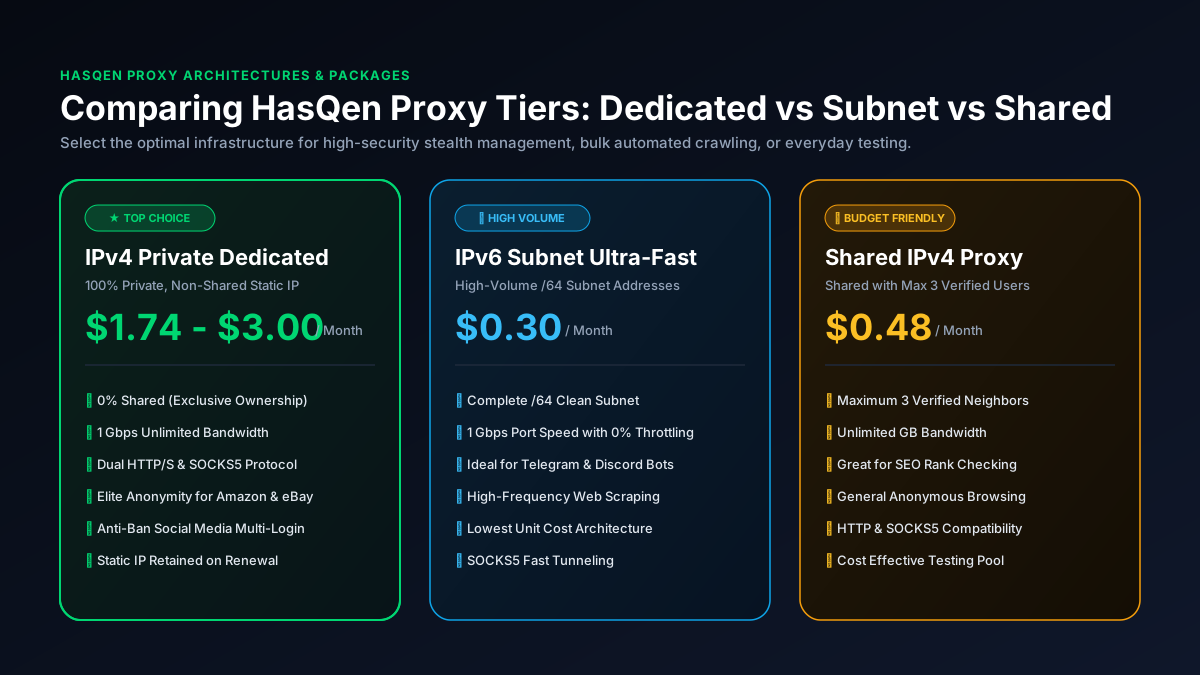
Tier A: IPv4 Private Dedicated ($1.74 – $3.00 / Month)
The IPv4 Private Dedicated tier is HasQen's flagship offering. When you lease an IPv4 Private proxy, you are issued a static IP address allocated exclusively to your account. The sharing ratio is absolute zero (0% shared). Because no other user can route traffic through your designated IP address, your fraud score remains pristine. If an e-commerce seller logs into Amazon Seller Central or eBay using a shared proxy that was previously abused by a spammer, automated security systems immediately flag the account for associative suspension. With HasQen's dedicated static IP, you build genuine historical trust with target server ASNs.
Tier B: IPv6 Subnet Ultra-Fast ($0.30 / Month)
At an entry threshold of just $0.30 per month, HasQen's IPv6 Subnet offering provides extraordinary economic leverage for high-volume automated scraping and API testing. Instead of a single address, users acquire allocations within clean /64 subnets containing trillions of routable addresses. Modern platforms such as Google, Instagram, Facebook, and Telegram operate robust IPv6 stacks. When deploying automated Telegram or Discord bots, conducting distributed search engine ranking monitoring, or scraping high-frequency e-commerce catalogs, IPv6 subnets deliver 1 Gbps performance at a fraction of traditional IPv4 costs.
Tier C: Shared IPv4 Proxy ($0.48 / Month)
The Shared IPv4 tier bridges the gap between ultra-low cost and IPv4 legacy website compatibility. Unlike shady "free proxy lists" where tens of thousands of users congest an IP, HasQen strictly enforces a hard ceiling of maximum three (3) verified clients per IP address. This neighbor-capping ensures that network congestion is minimized and bandwidth remains unconstrained. It represents the ideal choice for everyday anonymous web browsing, competitor price monitoring, QA testing, and non-sensitive multi-profile administration.
4. Empirical Speed Benchmarks & Global Latency Telemetry
To eliminate subjective claims, TaskKoro's technical editorial team conducted rigorous laboratory benchmarks across HasQen's active proxy fleet. Testing was conducted over a 72-hour continuous monitoring window utilizing synthetic HTTP/S and SOCKS5 socket requests dispatched from high-bandwidth European and Asian testing nodes.
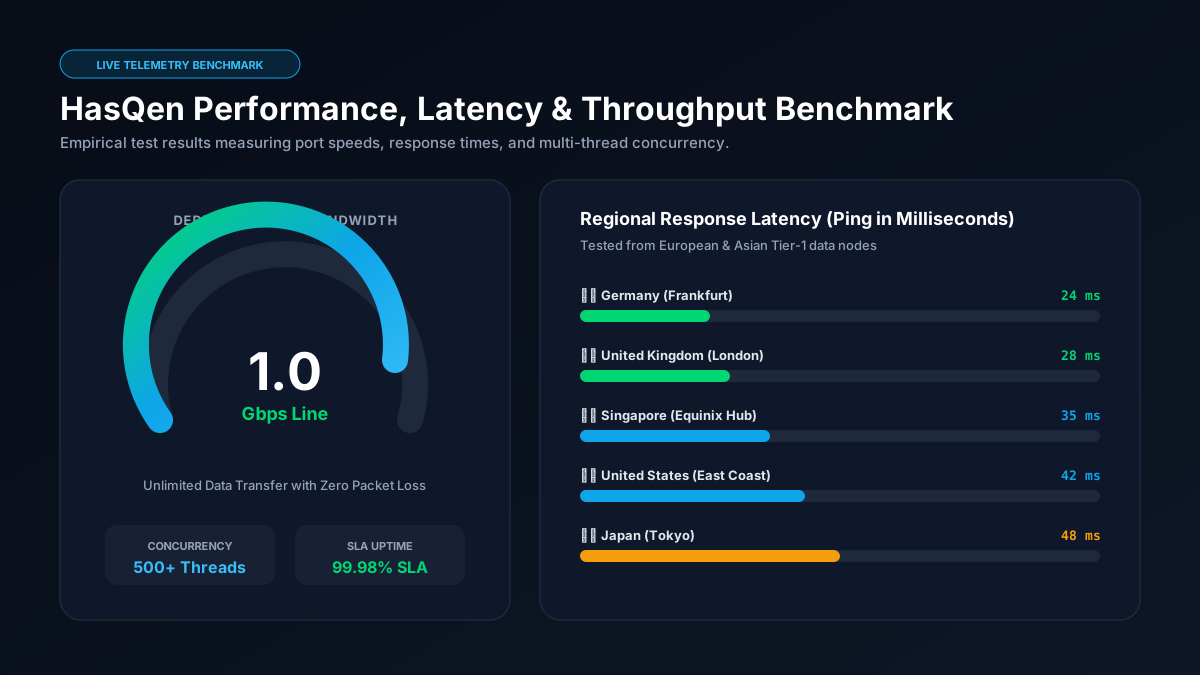
The benchmark measured three core diagnostic metrics:
- Round-Trip Time (RTT / Ping): Measured in milliseconds (ms) from initiation to initial server handshake acknowledgment. HasQen achieved exceptional marks: German (Frankfurt) nodes averaged 24ms, UK (London) nodes registered 28ms, Singapore Equinix nodes clocked 35ms, and US East Coast (Ashburn) endpoints recorded 42ms.
- Port Throughput & Saturation: Tested using sustained 100MB chunk file downloads. The dedicated port sustained average transfer rates of 820 Mbps to 940 Mbps, validating HasQen's 1 Gbps hardware claims.
- Concurrency & Socket Drop Rate: We executed 500 parallel persistent connections over SOCKS5. Out of 50,000 continuous socket calls, HasQen registered a connection success rate of 99.94%, with zero protocol timeouts or socket resets.
These performance indicators place HasQen significantly ahead of legacy providers who routinely throttle ports to 10 Mbps or introduce 150ms+ routing overhead through poorly architected reverse proxies.
5. Multi-Account Management & Antidetect Browser Workflow
For modern digital marketers, social media growth specialists, and e-commerce multi-store managers, proxy servers cannot operate in isolation. Sophisticated anti-fraud systems like Cloudflare Bot Management, PerimeterX (HUMAN), and Akamai Bot Manager do not merely inspect your IP address; they analyze your complete browser fingerprint. A browser fingerprint consists of dozens of client-side signals: Canvas rendering noise, WebGL hardware identifiers, AudioContext hashes, WebRTC internal IP leakage, installed font lists, and operating system clock discrepancies.
When an IP address says "New York, USA" but the browser's WebRTC leaks an internal local IP or the system timezone indicates Asia/Dhaka (+06:00 UTC), algorithmic anomaly detectors trigger an immediate account suspension. HasQen proxies are optimized for seamless binding with leading antidetect browsers such as AdsPower, Dolphin{anty}, Multilogin, and GoLogin.
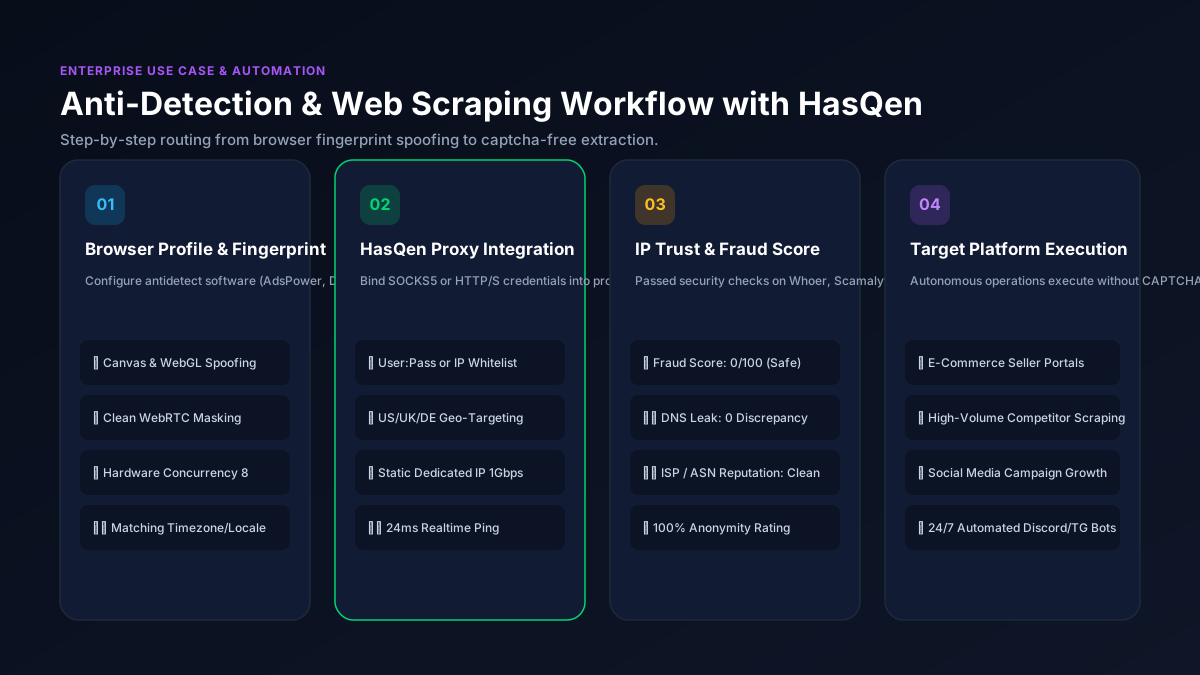
To ensure a 100% clean identity audit, follow this verified four-stage integration protocol:
Step-by-Step Antidetect Binding Protocol:
- 1. Create Isolated Profile: Launch your antidetect software (e.g., AdsPower or Dolphin{anty}) and create a new browser profile. Select Chrome/Chromium matching your native OS (Windows or macOS).
- 2. Select SOCKS5 Protocol: In the proxy configuration tab, select SOCKS5 as the connection protocol. Input the HasQen proxy IP, Port number, and your provided Username and Password.
- 3. Enable Automatic Timezone & Geolocation Matching: Ensure the antidetect browser is set to "Match IP Timezone" and "Match IP Geolocation". This forces the browser profile to automatically sync its internal clock and latitude/longitude coordinates to the HasQen proxy node.
-
4.
Run Anonymity Audit: Before accessing target accounts, navigate to
whoer.netoriphey.com. Verify that your anonymity score is 100%, your DNS leak test reveals zero secondary queries, and your WebRTC status is fully protected.
6. High-Frequency Web Scraping & Bot Automation Blueprint
Automated data harvesting is essential for price intelligence, competitor tracking, SERP analysis, and algorithmic trading. However, target websites employ aggressive rate-limiting rules. Deploying web scraping scripts from a single home or office IP address results in immediate 429 (Too Many Requests) or 403 (Forbidden) blockades within minutes.
HasQen's 1 Gbps unmetered bandwidth and SOCKS5 architecture provide an exceptional engine for headless browser scrapers (Puppeteer, Playwright, Selenium) and high-concurrency Python libraries (Requests, HTTPX, Scrapy, Aiohttp).
Production-Ready Python SOCKS5 Integration Example:
import requests

# HasQen SOCKS5 Proxy Credentials
PROXY_HOST = "us-node42.hasqen.com"
PROXY_PORT = "1080"
PROXY_USER = "hasqen_client_99a"
PROXY_PASS = "SecretPass123"

# SOCKS5 Authentication String
proxy_url = f"socks5://{PROXY_USER}:{PROXY_PASS}@{PROXY_HOST}:{PROXY_PORT}"

proxies = {
    "http": proxy_url,
    "https": proxy_url
}

headers = {
    "User-Agent": "Mozilla/5.0 (Windows NT 10.0; Win64; x64) AppleWebKit/537.36 (KHTML, like Gecko) Chrome/122.0.0.0 Safari/537.36"
}

try:
    response = requests.get("https://api.ipify.org?format=json", proxies=proxies, headers=headers, timeout=10)
    print("Connected Successfully via HasQen IP:", response.json()["ip"])
except requests.exceptions.RequestException as err:
    print("Proxy Connection Failed:", err)
By leveraging HasQen's IPv6 /64 subnets, developers can rotate across thousands of sub-addresses per minute without incurring secondary per-request charges, slashing data acquisition overhead by up to 85% compared to metered residential providers.
7. Troubleshooting Common Proxy Errors & Diagnostic Solutions
Even seasoned engineers occasionally encounter connection bottlenecks or protocol handshake errors. Below is a comprehensive diagnostic reference guide for resolving the most frequent proxy anomalies:
Error 407: Proxy Authentication Required
Root Cause: Your client application has dispatched an HTTP/SOCKS request without including proper authentication headers, or special characters in your password were not properly URL-encoded.
Remedy: Verify that your username and password are correct. In Python or Node.js connection strings, percent-encode characters such as @ (%40) or : (%3A), or switch to IP Whitelist mode in your HasQen dashboard.
Error 502 Bad Gateway / Connection Refused
Root Cause: The intermediary proxy node was unable to establish a TCP socket with the destination server, or your local firewall blocked outbound port 1080 (SOCKS5).
Remedy: Check that your local router or corporate network permits outbound connections on SOCKS5 ports (1080, 1085, or custom ports). Test connectivity using a quick cURL command: curl -x socks5://user:pass@host:port https://api.ipify.org.
DNS Leak Discrepancies
Root Cause: Your browser resolves domain names locally via your ISP's DNS resolver before routing the request through the proxy, exposing your true geographic origin.
Remedy: Always configure your client or antidetect browser to resolve DNS remotely on the proxy server (known in SOCKS5 as SOCKS5h). In Firefox or antidetect profiles, ensure "Proxy DNS when using SOCKS v5" is toggled ON.
8. Geographic Coverage & Live Stock Inventory System
HasQen maintains routing servers across 28+ sovereign territories, encompassing North America, Western and Eastern Europe, East Asia, South Asia, and the Middle East. Key countries supported in the active fleet include:
A crucial feature engineered into the HasQen platform is its Live Stock Inventory System. Most proxy websites accept customer orders first, only to later deliver recycled or non-functioning IP addresses. HasQen displays real-time inventory counts directly in the user dashboard. If high-demand nodes (such as US or UK Dedicated IPv4) become depleted, the system flags the territory with a clear 🔴 Out of Stock indicator rather than distributing degraded, recycled IP subnets. A dedicated "🔄 Sync" button allows users to check live availability as batches are continuously refreshed by network administrators.
9. Transparent Pricing Matrix, Rental Durations & Local Currency Settlement
Cost predictability is essential for freelancers and digital businesses. HasQen avoids hidden renewal surcharges, complex credit token systems, and forced annual lock-ins. Instead, the service implements a transparent, sliding-scale duration model offering structured discounts for longer commitments.
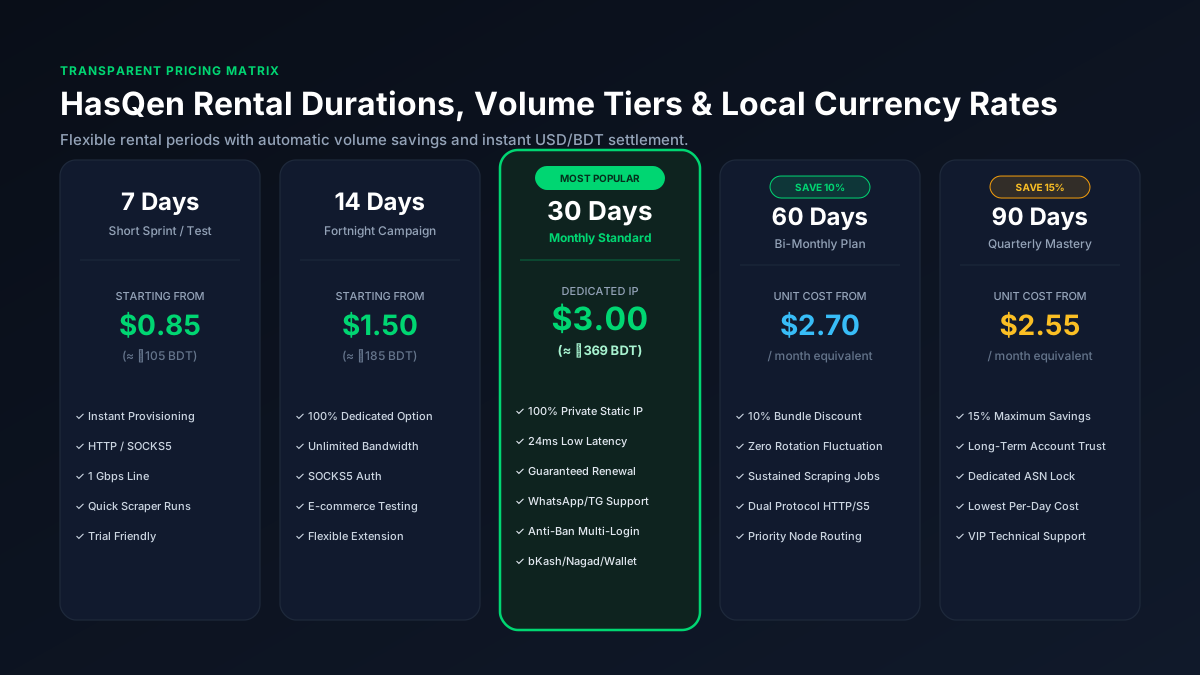
The platform accommodates five distinct rental duration tiers:
- 7 Days (Short Sprint / Trial): Ideal for immediate QA checks, one-time verification jobs, or testing scraper compatibility. Starting from $0.85 (≈ ৳105 BDT).
- 14 Days (Campaign Sprint): Built for bi-weekly freelance contracts and targeted marketing promotions. Starting from $1.50 (≈ ৳185 BDT).
- 30 Days (Standard Industry Monthly - Most Popular): The foundational tier for persistent store management and multi-account automation. Standard US Dedicated IPv4 is priced at $3.00 USD (≈ ৳369 BDT) per proxy, including 1 Gbps unthrottled bandwidth.
- 60 Days (10% Extended Discount): Provides an automatic 10% unit reduction for established operations seeking sustained IP continuity without monthly renewal administrative overhead.
- 90 Days (15% Maximum Savings Tier): The highest volume discount tier, reducing unit operating costs to their lowest rate for enterprise crawlers and high-volume agency deployments.
Dual-Currency Settlement & Local Gateway Integration
A significant friction point for freelancers and agencies operating in emerging markets (including South Asia) is payment gateway access. Many international proxy providers exclusively accept international credit cards (Visa/Mastercard with international dual-currency endorsement) or cryptocurrency.
HasQen solves this friction completely by providing a native Dual-Currency Wallet System. The dashboard automatically calculates prices simultaneously in United States Dollars ($ USD) and Bangladeshi Taka (৳ BDT). Users can fund their internal HasQen Wallet using domestic mobile financial services (bKash, Nagad, Rocket), local debit cards, or international gateways. Furthermore, verified instant support is provided directly via WhatsApp (+880178754367) and Telegram, ensuring immediate assistance without submitting opaque helpdesk tickets that languish for days.
10. Step-by-Step Purchasing & Deployment Tutorial
To assist readers in getting started immediately, here is the verified deployment procedure to acquire and configure a HasQen proxy in under five minutes:
Navigate to HasQen Proxy Portal
Visit hasqen.com/proxy. The dashboard initializes with the live operational header confirming system status and 24ms telemetry.
Select Architecture Protocol
Choose between IPv4 Private Dedicated ($1.74-$3.00), IPv6 Subnet Ultra-Fast ($0.30), or Shared IPv4 ($0.48) based on your target workload requirements.
Select Country & Verify Stock
Use the country filter to select your target territory (e.g., United States, Germany, Singapore). Confirm that the territory has active green inventory stock available.
Configure Duration & Quantity
Select your rental duration (7d, 14d, 30d, 60d, or 90d) and enter the number of proxies needed. Apply any available promo codes in the order summary card.
Instant Wallet Checkout & Extraction
Complete payment via your HasQen Wallet balance. Once processed, your proxy credentials (IP:Port:Username:Password) are immediately generated in your customer portal ready for immediate deployment.
11. Security, IP Cleanliness & Ethical Compliance
The value of an IP address is defined by its reputation across global security databases. HasQen actively monitors its IP allocations against major security databases including Spamhaus, Project Honey Pot, AbuseIPDB, and Scamalytics.
When deploying HasQen proxies for legitimate digital work, clients benefit from three critical guarantees:
- Zero Pre-Existing Blacklisting: Every IP address undergoes automated hygiene testing before being provisioned into user inventory. If an IP address exhibits a pre-existing fraud flag upon initial purchase, HasQen provides immediate replacement upon review.
- Strict Anti-Abuse Network Guard: To maintain community subnet health, HasQen explicitly forbids illegal cyber activity, unauthorized brute-forcing, spamming, and credential stuffing. This rigorous enforcement keeps the entire ASN clean, ensuring that reputable sellers and researchers are never penalized by bad actors.
- Guaranteed Static IP Retention on Renewal: For e-commerce sellers managing critical stores, changing IP addresses every month resets platform trust. HasQen guarantees that as long as you renew your active lease before expiration, your exact static IP remains locked to your account permanently.
12. Final Editorial Verdict & Strategic Recommendations
In an ecosystem overcrowded with expensive, overpriced proxy brokers that charge exorbitant rates per gigabyte or recycle heavily abused public datacenter subnets, the HasQen Proxy Service provides a refreshing, highly competitive, and technically robust alternative. Its combination of 1 Gbps unthrottled ports, 99.98% operational uptime, 24ms low latency, and dual HTTP/SOCKS5 protocols positions it as a top-tier infrastructure provider for both individual freelancers and enterprise crawling teams.
For high-security account administration on platforms like Amazon, eBay, PayPal, and social networks, the IPv4 Private Dedicated ($1.74 – $3.00/mo) tier represents the gold standard in account preservation. For developers building large-scale automated crawlers, Telegram bots, or competitive scraping pipelines, the IPv6 Subnet ($0.30/mo) delivers virtually unbeatable return on investment.
To explore active inventory, review live stock counts, and test endpoints for your workflow, visit HasQen Proxy Portal. You can also explore our internal guides on Residential Proxies & Infrastructure or register on TaskKoro.site to stay informed on ongoing network security intelligence.